Bathroom comparisons
Shower Panels vs Tile: What You Pay, What You Clean, What the Warranty Pays
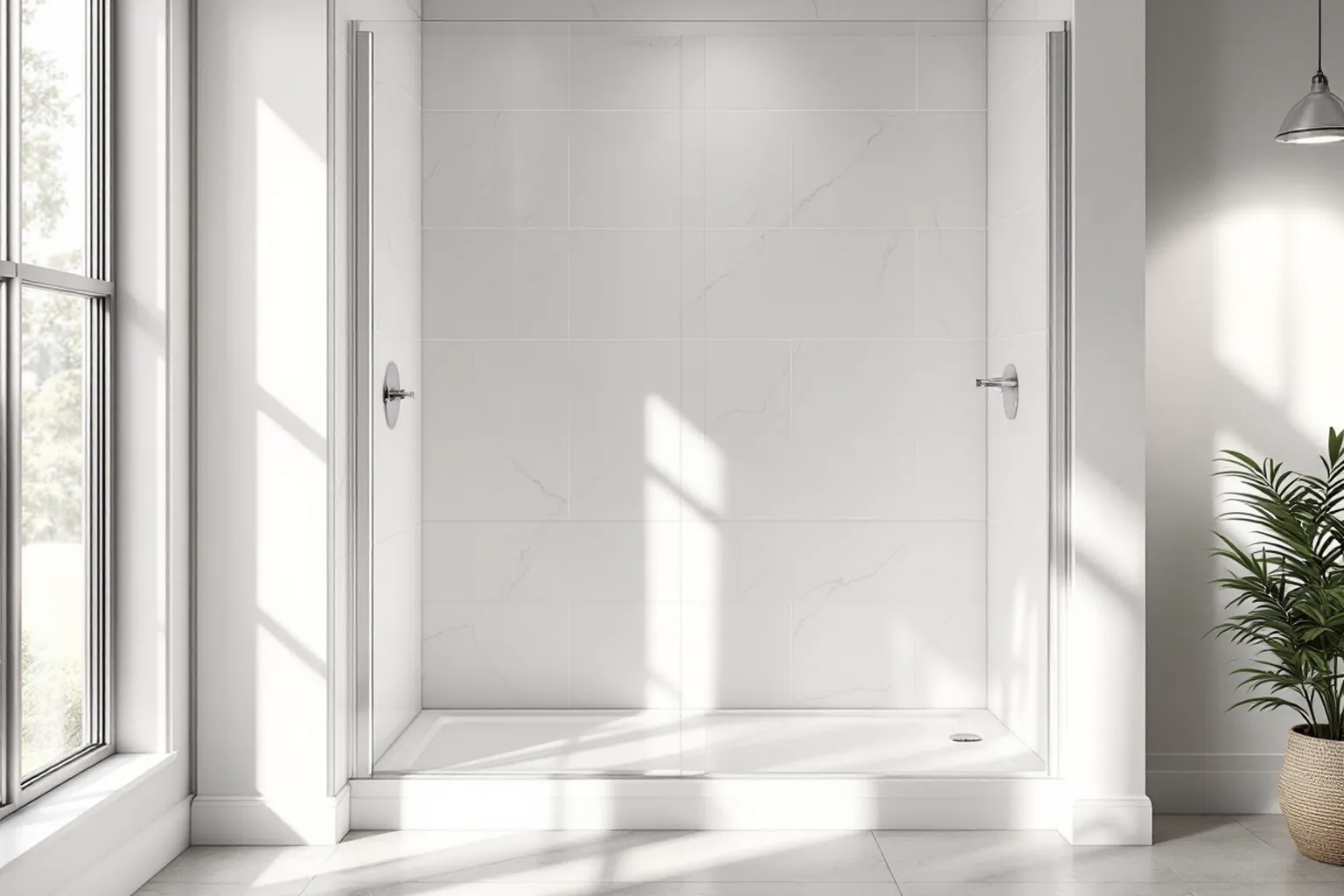
Shower panels vs tile comes down to three numbers: price, joints and who pays when something fails. A basic modular panel surround starts at $770 to $960 installed in Homewyse‘s May 2026 estimate, while a tiled shower averages $2,700 at Fixr, but premium panels are not cheap: Block Renovation prices solid surface walls at $4,500 to $10,000. Panels erase about 385 feet of grout joint in a 60 by 32 inch alcove tiled in 3x6 subway (our calculation), yet of the eight panel warranties we read, only Shaw’s says in writing that it pays installation labor. Tile keeps the edge on looks, repairability and ceiling height.
- Low
- $770 installed
- Tiled shower average
- $2,700 installed
- High
- $10,000 installed
Eight panel warranties, read for who pays the installer
Every panel ad says “lifetime warranty” somewhere. We opened the current warranty document for eight wall products sold in the US, from a one-year acrylic kit to dealer-installed systems, and pulled the four terms that decide whether a claim actually saves you money: how long, whether labor is paid, whether it survives a sale, and the condition most likely to void it. All rows come from the makers’ own documents, listed under the table.
| Product | Residential term | Pays labor? | Transfers? | Catch |
|---|---|---|---|---|
| DreamLine acrylic wall panels | 1 year, parts only | No | No, original buyer in the home | Claim within 30 days of finding the defect |
| Wilsonart Wetwall | 10 years from sale | No; capped at purchase price | No, original buyer | Must register online within 30 days |
| Kohler Choreograph walls | 10 years from purchase | No; capped at purchase price | No, original end user | Improper cleaning voids it |
| Shaw WaterPrep shower wall | At least 7 years | Yes: product, freight, labor (not for looks defects) | No, first purchaser | Install and maintain per Shaw guidelines |
| Swanstone wall panels | Limited lifetime, in original place | No labor or removal | No, original purchaser | Excludes seams and fabricator changes |
| InnovaShowers wall system | Limited lifetime while you own and live there | No; capped at 100% of panel price | Finish clause only, on a valid transfer | Approved backer, adhesive and sealant only |
| Kohler LuxStone | Lifetime while original owner owns the home | Kohler: defects only; dealer labor warranty is separate | No | Kohler Certified installer required |
| Bath Fitter acrylic walls | Lifetime | Page says repair or replace at no cost; labor not spelled out | Yes, if bought after June 5, 2023 | Sold and installed only by Bath Fitter |
Sources: DreamLine Limited Warranty, rev. Feb 2022; Wilsonart Wetwall Residential 10-Year Limited Warranty; Kohler Choreograph Ten-Year Limited Warranty, updated 09/09/2025; Shaw WaterPrep Shower Wall Covering Residential Limited Warranty, rev. 04/29/2021; Swan Corporation warranty schedule (2022 copy hosted by Vintage Tub and Bath); InnovaShowers Wall Panel Warranty 2026; Kohler LuxStone Shower warranty sheet (dealer copy, 2025); Bath Fitter lifetime warranty page. Read 2026-11-24.
Lifetime on the box usually means parts, original owner, original spot
Read side by side, the eight documents say the same thing in different fonts. Swan will “repair, or at our option, exchange the product” but its warranty “does not cover any labor or other costs of removal or installations” and applies only while the panel “remains in use in its original place of installation.” Wilsonart and Kohler Choreograph both cap their liability at the purchase price of the product, so the best case after a defect is a free box of panels and a second installation bill. DreamLine gives its own DreamStone panels a lifetime limited warranty but its acrylic wall panels one year, parts only.
The outlier is Shaw: its WaterPrep warranty is shorter, at least 7 years, but states that Shaw “will pay the reasonable costs for product, freight and labor” for covered defects, except appearance defects. Dealer-installed systems close the labor gap differently. Kohler LuxStone requires a Kohler Certified installer, and the dealer sheet we read adds the dealer’s own labor warranty for as long as you own the home; that second promise is only as good as the local dealer. Bath Fitter made its acrylic warranty transferable for purchases after June 5, 2023, which none of the other seven do in full.
Tile has the same structure one layer down. The membrane warranties we compiled for how long tile showers last also stop at the original owner and cap payouts at what the job cost per square foot. Neither material comes with a promise that pays for a rotten wall.
A 60 by 32 inch alcove in 3x6 subway has 385 feet of grout joint
“No grout” is the main pitch for panels, so we measured what it removes. Our calculation uses a common alcove: a 60 inch back wall and two 32 inch side walls, finished to 80 inches high to match the height of standard panel kits, for 68.9 sq ft of wall. Tiles are set with 1/8 inch joints. For each wall, joint length is (rows minus 1) times wall width plus (columns minus 1) times wall height, summed over the three walls; exposed grout area is joint length times 1/8 inch. Running bond shifts vertical joints but barely changes the total. Inside corners and the base line (about 24 feet of caulk) are the same for tile and panels, so they are left out.
| Wall finish | Pieces incl. cuts | Grout joint length | Exposed grout |
|---|---|---|---|
| 2x2 mosaic | about 2,318 | 769 ft | 8.0 sq ft |
| 3x6 subway, laid flat | about 572 | 385 ft | 4.0 sq ft |
| 4x4 | about 620 | 383 ft | 4.0 sq ft |
| 4x12 | about 220 | 250 ft | 2.6 sq ft |
| 12x24 | about 49 | 89 ft | 0.9 sq ft |
| 24x48 porcelain | about 16 | 38 ft | 0.4 sq ft |
| 3-piece panel kit | 3 panels | 0 ft field joints | 0 sq ft |
Source: our calculation, 60 x 32 x 80 inch alcove, 1/8 inch joints; method in the paragraph above.
Big tile gets you most of the way to a grout-free wall
The table shows why the panel pitch lands hardest against small tile. A mosaic wall has about 8 sq ft of exposed grout, roughly the area of a door; a 12x24 layout has under 1 sq ft, and 24x48 porcelain is down to 38 feet of joint (our calculation). If you want stone or tile looks and low cleaning, large-format porcelain with epoxy or urethane grout closes most of the gap. Innovate Building Solutions, a panel seller, concedes that those grouts reduce the mold and cleaning problem but calls them hard to work with, which shows up as labor cost.
What grout count does not tell you is where water gets in. On a tile wall, water that passes the grout is stopped by the membrane behind it. On a panel wall, the surface is the barrier, so the joints that matter are the corner seams, trim channels and fixture cutouts, all sealed with silicone that needs recaulking.
Panels move the risk to the backer, the corners and the ceiling height
- The wall behind still matters. The InnovaShowers warranty requires panels in wet areas to be mounted on an approved board or membrane such as cement board, Kerdi-Board, DensShield or Hardiebacker, and voids coverage if you use an adhesive or sealant not on its list.
- Glue, not screws. The Swan installation guide mounts panels with 100% silicone and foam tape only, warns never to use nails or screws, and says not to install below 55°F. Grab bars must be anchored to studs behind the panels, so plan blocking before the walls go up.
- Sizes run out. Innovate notes that standard panels are easy to find for an 8 foot ceiling and much more limited at 9 feet, and wide walls can need a visible seam trim.
- Repairs are all or nothing. A cracked tile can be cut out and replaced; a gouged panel usually means a new sheet, and Wilsonart warns that exact color matches may not be possible if your style is discontinued.
What each wall finish costs installed, by whose numbers
“Panel” covers everything from a three-piece plastic kit to slab-like solid surface, so installed prices run from hundreds of dollars to five figures. The ranges below are each publisher’s own, with their basis; they are not directly additive. Fixr’s tile figure covers a whole small shower including a mosaic floor, while Block Renovation‘s panel figures are walls only, with pan, door and fixtures extra.
| Finish | Installed range | Whose figure | Basis |
|---|---|---|---|
| Basic modular surround (3-piece) | $770 to $960 | Homewyse | Per surround, May 2026 |
| FRP panels | $1,000 to $2,500 | Block Renovation | 3 alcove walls, 70 to 100 sq ft |
| PVC panels | $1,000 to $3,000 | Block Renovation | Same basis |
| Laminated panels | $2,500 to $6,000 | Block Renovation | Same basis |
| Acrylic surround kit | $2,500 to $6,500 | Block Renovation | Same basis |
| Cultured marble | $3,000 to $7,000 | Block Renovation | Same basis |
| Solid surface | $4,500 to $10,000 | Block Renovation | Same basis |
| Tiled shower, whole | $1,800 to $5,000; avg $2,700 | Fixr | 3x4 ft shower, 8 ft walls, mosaic floor |
| Tile labor only, our 68.9 sq ft alcove | $276 to $1,034 | Fixr rate x area | Our calculation: $4 to $15 per sq ft |
Sources: Homewyse, Cost to Install a Shower Surround (May 2026); Block Renovation, Shower Panel Types (Aug 2026); Fixr, Shower Tiling Cost (updated Aug 29, 2025). Labor row is our calculation.
Panels win on price only at the budget end
At the low end the gap is real. A three-piece surround at Homewyse‘s $770 to $960 is a fraction of Fixr‘s $2,700 average tiled shower, and installers quote a day or two for panels against a week or longer for tile, per Innovate. Fixr also puts tile labor at $4 to $15 per sq ft, which is $276 to $1,034 for our 68.9 sq ft alcove walls before materials, waterproofing and the pan (our calculation).
Move up to the panels sold as tile alternatives and the order flips. This Old House puts a prefabricated acrylic or fiberglass shower at $3,000 to $6,000 with installation, and Block Renovation’s acrylic, cultured marble and solid surface ranges all start above Fixr’s tiled shower average. One remodeling contractor, Northbuilt Construction, quotes $3,500 to $9,000 for tiling about 90 sq ft of walls and $12,000 to $16,000 for panel systems; it does not state its basis, but it shows that “panels are cheaper” is a claim about kits, not about every product with no grout lines.
For a full tub-to-shower job, the walls are one line of the bill; our tub to shower conversion cost breakdown shows the pan, valve and glass that sit on top of either finish.
Five questions that separate a good panel or tile bid
- Step 1
What is behind the finish?
Ask for the backer board and membrane by product name. Panels still need a wet-area backer under most warranties; tile needs a membrane.
- Step 2
Whose warranty pays labor?
Most maker warranties above exclude it. Ask whether the installer adds a written labor warranty, as the LuxStone dealer sheet does, and for how long.
- Step 3
Does the warranty need registration?
Wilsonart requires online registration within 30 days; ask the installer to do it or give you the paperwork.
- Step 4
Where are the seams?
For panels, ask for a layout showing any seam trims and the fixture cutouts. For tile, ask for tile size and grout type.
- Step 5
Is grab bar blocking included?
Panels cannot carry a grab bar on their own, per the Swan guide; blocking costs little with the wall open and a lot later.
Frequently Asked Questions
What are the disadvantages of shower panels?
Fewer looks and sizes than tile, visible seam trims on wide walls, limited options above an 8 foot ceiling per Innovate Building Solutions, and repairs that mean replacing a whole sheet. Most warranties also exclude labor: Swan, Wilsonart and Kohler Choreograph pay for product only.
Is it cheaper to tile a shower or use panels?
A basic panel kit is cheaper: $770 to $960 installed at Homewyse against a $2,700 average tiled shower at Fixr. Premium panels are not; Block Renovation puts acrylic kits at $2,500 to $6,500 and solid surface at $4,500 to $10,000 for three alcove walls.
Are shower wall panels better than tiles?
Better for cleaning and install speed: a 3-piece kit removes about 385 feet of grout joint compared with 3x6 subway in a 60 by 32 inch alcove (our calculation). Tile is better for design range, tall walls, curbless layouts and spot repairs, and large-format tile cuts grout to under 90 feet in the same alcove.
What is the best material for a walk-in shower?
Porcelain tile over a bonded waterproofing membrane is the usual choice, because walk-in and curbless showers need a sloped floor and custom sizes that stock panels rarely fit. Solid surface panels work on standard walls but cost $4,500 to $10,000 at Block Renovation. See our walk-in shower cost guide for the full build.
Sources
- Homewyse, Cost to Install a Shower Surround (2026)
- Fixr, How much does it cost to tile a shower? (2025)
- Block Renovation, Shower Panel Types: costs and materials (2026)
- This Old House, Shower Remodel Cost (2026)
- DreamLine (Bath Authority), DreamLine Exclusive Limited Warranty, revised Feb 2022 (2022)
- Wilsonart, Wetwall Residential 10-Year Limited Warranty
- Kohler, KOHLER Choreograph Walls and Accessories Ten-Year Limited Warranty (2025)
- Shaw Industries, Shaw WaterPrep Shower Wall Covering Residential Limited Warranty (2021)
- The Swan Corporation, Swanstone Limited Warranty schedule (retailer-hosted copy) (2022)
- The Swan Corporation, Swan wall installation guide, shower walls with tape
- Innovate Building Solutions, InnovaShowers Wall Panel Warranty 2026 (2026)
- Innovate Building Solutions, Advantages and disadvantages of shower wall panels vs. tile (2024)
- Kohler (dealer copy, Statewide Remodeling), Your KOHLER LuxStone Shower Warranty (2025)
- Bath Fitter, Lifetime Warranty
- Northbuilt Construction, Tile vs Panel Shower: The Better Choice Explained