Kitchen comparisons
Stock vs Semi Custom Cabinets: What 10 Named Lines Actually Publish
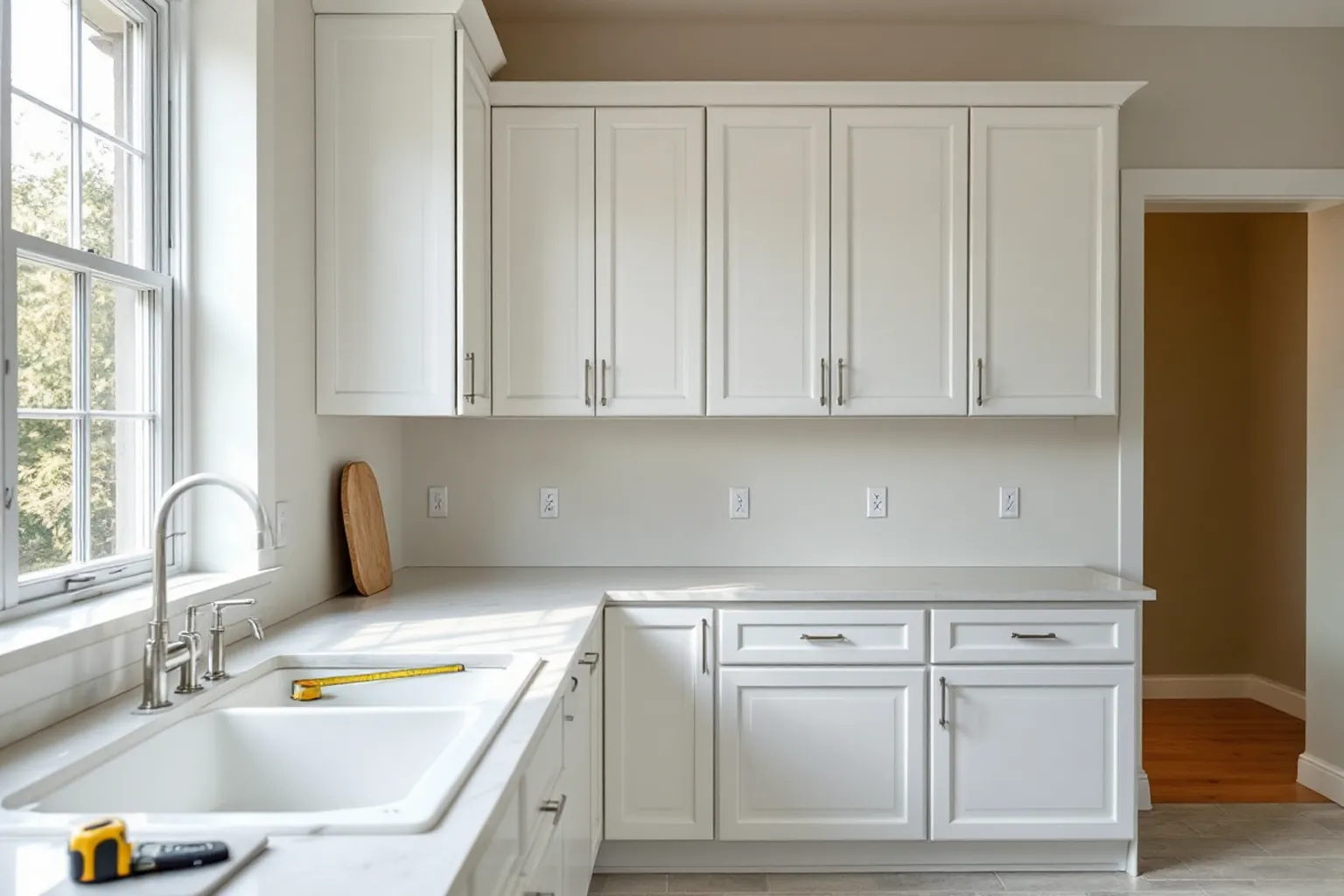
The real difference in stock vs semi custom cabinets is three things you can measure: stock boxes come in fixed widths (usually 3-inch steps), ship in days to about two weeks, and cost $100 to $300 per linear foot, while semi-custom boxes are built to order from a catalog, can be resized for an upcharge, take longer, and cost $150 to $650 per linear foot, according to HomeAdvisor. What the label does not tell you is box material, warranty length or test certification. We read the spec sheets, warranties and certificates of 10 named lines, and those three facts vary more inside each category than between them.
- Low
- $4,500 30 linear ft of semi-custom cabinets
- Midpoint
- $12,000 30 linear ft of semi-custom cabinets
- High
- $19,500 30 linear ft of semi-custom cabinets
Semi-custom roughly doubles the cabinet line at the midpoint
HomeAdvisor and Fixr publish the same per-foot ranges: stock $100 to $300, semi-custom $150 to $650, custom $500 to $1,200. We multiplied those by three common run lengths. The midpoint column uses $200 per foot for stock and $400 for semi-custom, our calculation.
| Cabinet run | Stock | Semi-custom | Midpoint gap |
|---|---|---|---|
| 20 linear ft | $2,000 to $6,000 | $3,000 to $13,000 | $4,000 vs $8,000 |
| 30 linear ft | $3,000 to $9,000 | $4,500 to $19,500 | $6,000 vs $12,000 |
| 40 linear ft | $4,000 to $12,000 | $6,000 to $26,000 | $8,000 vs $16,000 |
Our calculation from per-linear-foot ranges published by HomeAdvisor and Fixr (2026). Ranges overlap: a premium stock line can cost more than an entry semi-custom one.
Stock means fixed sizes, semi-custom means a catalog you can bend
Neither word is a regulated term. The Kitchen Cabinet Manufacturers Association describes semi-custom as cabinets built to order but within a defined set of construction parameters, as quoted by Fine Homebuilding. That article (2014, still the clearest description we found) says semi-custom boxes start in the same 3-inch width steps from 9 to 45 inches, and for an upcharge the width can be changed in 1/8-inch steps, with depth and height also adjustable.
Stock lines sell a fixed list of boxes. The Hampton Bay Designer Series spec guide from American Woodmark lists wall cabinets from 9 to 36 inches wide in 3-inch steps. IKEA’s SEKTION base frame comes in 12, 15, 18, 21, 24, 30 and 36 inch widths per IKEA, so above 24 inches the steps jump to 6 inches.
Retail has blurred the middle. Lowe’s sells Diamond Express, a pick-from-a-short-list line, with all-plywood boxes and a ship time of 15 days or less, and 5 days for best sellers, per its Lowe’s Diamond Express brochure. That is faster than many stock special orders and better built than many stock boxes. Judge the line, not the label.
What 10 cabinet lines publish about boxes, warranty and certification
We read each line’s own warranty, spec guide or brochure, or the retailer’s spec document, on 21 November 2026, and checked every maker against KCMA’s Find a Certified Company directory. “Not stated” means the page we read did not say; it does not mean the feature is missing.
| Line (maker) | Box material | Warranty | Lead time stated | KCMA directory |
|---|---|---|---|---|
| IKEA SEKTION (IKEA) | 3/4 in particleboard, melamine | 25-year limited | Not stated (sold from store stock) | Not listed; flat pack |
| Hampton Bay Designer Series (American Woodmark) | Furniture board, frameless | Limited lifetime, original buyer | Ships in two weeks, 5-cabinet minimum | Maker listed |
| Wolf Classic (Wolf Home Products) | 1/2 in plywood sides, back, top | Limited lifetime; 5 years commercial | Quick Ship SKUs, no day count | Certified, cert. 26027 |
| Diamond Express (MasterBrand, Lowe’s) | All plywood | Limited lifetime | 15 days or less; 5 for best sellers | Maker not listed |
| Diamond Vibe, Distinction, Edge (MasterBrand) | Edge: all plywood; others not stated | Limited lifetime | Not stated | Maker not listed |
| KraftMaid (MasterBrand) | Not stated | Limited lifetime, original buyer | Not stated | Maker not listed |
| Thomasville Cabinetry (MasterBrand) | Not stated | Limited lifetime (bought from 15 Apr 2025) | Not stated | Maker not listed |
| Aristokraft (MasterBrand) | Not stated | 5 years; lifetime on hinges and glides | Not stated | Maker not listed |
| Merillat Classic (MasterBrand) | 3/8 in engineered wood ends; plywood upgrade | 25-year limited (2020 brochure) | Not stated | Maker not listed; brochure cites KCMA standards |
| Wellborn Select (Wellborn Cabinet) | 3/4 in furniture board; all-plywood option | Limited; terms by series | Not stated; custom colors add 2 weeks (Aspire) | Maker listed |
Sources: IKEA; American Woodmark HBDS spec guide (Sept 2025); Wolf sell sheet, Wolf warranty, KCMA certificate; Lowe’s; Diamond; KraftMaid; Thomasville; Aristokraft; Merillat Classic brochure (2020, dealer copy); Wellborn Select catalog, Wellborn Aspire catalog; KCMA directory. All accessed 21 Nov 2026.
Only 2 of the 10 put a number on lead time
Counting the table above (our calculation):
- Warranty length: 9 of 10 state one. Six say limited lifetime, two say 25 years (IKEA, Merillat Classic), and Aristokraft gives 5 years on the cabinet with lifetime coverage only on hinges and drawer glides, per Aristokraft. Wellborn’s pages we read say only “limited warranties” by series.
- Box material: 7 of 10 say what the box is made of. Three MasterBrand lines (KraftMaid, Thomasville, Aristokraft) did not on the pages we read.
- Lead time: 2 of 10 give a number: two weeks for Hampton Bay Designer Series and 15 days for Diamond Express. Wellborn’s Aspire catalog gives only a relative figure, two weeks added to its standard lead time for custom ColorInspire colors, per the Wellborn Aspire catalog. Nobody else published days or weeks, so ask for a written ship date.
- KCMA directory: 3 of the 10 lines come from makers listed (American Woodmark, Wolf, Wellborn). None of the six MasterBrand lines appeared under a MasterBrand name when we searched KCMA’s directory, although Merillat’s 2020 brochure says its cabinets meet and exceed KCMA standards.
The split does not follow stock vs semi-custom. A stock line (Wolf Classic) has a current KCMA certificate and plywood boxes; a semi-custom line (Wellborn Select) starts with furniture board and sells plywood as an option. That is why the box and certificate questions in the checklist below matter more than the category name.
What the KCMA seal actually tests
KCMA certification means a line passed ANSI/KCMA A161.1, the industry’s performance and construction standard. The 2022 edition, published by KCMA, sets these pass marks:
- Shelves and cabinet bottoms carry 15 lb per square foot for seven days and may sag no more than 1/16 inch per foot, per the A161.1 text.
- A hung wall cabinet up to 36 inches wide holds 600 lb with no failure of the cabinet or its mounting, per the same standard.
- Doors survive 25,000 open-close cycles, and a door held open carries 65 lb for 10 cycles with sag limited to 0.065 inch, per A161.1.
- Drawers loaded at 15 lb per square foot run 25,000 cycles, per A161.1.
- Finish tests include 24 hours at 120°F and 70% humidity, five hot-cold cycles down to minus 5°F, and 24-hour exposure to vinegar, coffee, juices, olive oil and 100-proof alcohol, per A161.1.
Two limits matter for shoppers. The seal covers the specific door styles and finishes named on a certificate: Wolf’s Impact Series certificate lists its Grantley and Grove door lines and expires 31 May 2027, per KCMA. And the same certificate says flat-pack (unassembled) and unfinished cabinets are not certified, which rules out most ready-to-assemble stock. A brochure that says “meets KCMA standards” is a claim; a dated certificate naming the door style you picked is proof.
Lifetime warranties exclude more than they suggest
A lifetime label does not mean the same thing across makers. The Thomasville warranty, per Thomasville Cabinetry, covers only the original owner of a primary or secondary home, excludes rentals and vacation rentals, does not pay labor, and excludes warping that shows up after the first 365 days and shelf loads above 15 lb per square foot. Aristokraft’s warranty uses the same 15 lb shelf limit and calls temperatures outside 50 to 85°F and humidity outside 30 to 55% extreme, per Aristokraft.
That 15 lb figure is the KCMA test load, so a shelf of cast-iron pans or canned goods can sit outside both the test and the warranty. Wolf’s lifetime coverage drops to five years for commercial buyers, which can include a condo association, per Wolf Home Products. If you are buying cabinets for a rental, read the warranty before you compare prices; several of the lifetime promises in the table do not apply to you at all.
Fixed 3-inch widths leave up to 2 7/8 inches of filler per wall
Because stock boxes come in 3-inch steps, the boxes on a wall can only add up to a multiple of 3 inches. Whatever is left becomes filler strips. Leftover = run length minus the largest multiple of 3 that fits, our calculation. Semi-custom width changes in 1/8-inch steps, as described by Fine Homebuilding, shrink the forced leftover to under 1/8 inch, though designers still add a small filler at a wall so doors and drawers clear.
| Wall run | Stock boxes total | Forced filler | With 1/8 in mods |
|---|---|---|---|
| 96 in | 96 in | 0 in | 0 in |
| 100 in | 99 in | 1 in | Under 1/8 in |
| 110 in | 108 in | 2 in | Under 1/8 in |
| 120 1/2 in | 120 in | 1/2 in | Under 1/8 in |
| 131 1/2 in | 129 in | 2 1/2 in | Under 1/8 in |
| 145 in | 144 in | 1 in | Under 1/8 in |
Our calculation, assuming widths in 3-inch steps as listed in the Hampton Bay Designer Series spec guide and 1/8-inch modifications per Fine Homebuilding. Real layouts also lose width to corner fillers and appliance gaps.
Two inches of filler is fine on a wall, costly at an appliance
A 2 1/2 inch strip split between two ends of a wall is barely visible. It matters in three places: beside a range or refrigerator opening, where every inch of opening width is fixed by the appliance; in a corner, where Hampton Bay’s spec guide already calls for a minimum 1-inch filler beside some cabinets, per American Woodmark; and in older homes with out-of-square walls, where you need room to scribe. With IKEA SEKTION, the missing 27 and 33 inch widths mean a gap can reach 5 inches or more on a short run unless you mix widths, per IKEA’s width list on ikea.com.
If your measurements leave less than an inch everywhere, stock costs you nothing in fit. If two or more walls land near the 2 inch mark, price a semi-custom quote with width modifications on just those boxes, or mix lines: many kitchens use stock boxes on long walls and a few modified boxes at the range.
Five questions that decide it faster than the label
- Step 1
Do your wall runs leave over 2 inches of filler?
Run the filler math above for each wall. Under 1 inch everywhere favors stock; big gaps at the range or fridge favor semi-custom.
- Step 2
What is the box made of?
Ask for the spec sheet. Furniture board and particleboard boxes are standard in lines such as Hampton Bay Designer Series and Wellborn Select; plywood is standard in Wolf Classic and Diamond Express. Composite boxes must meet federal formaldehyde limits, explained in our guide to formaldehyde in kitchen cabinets.
- Step 3
Is there a current KCMA certificate for your door style?
Ask the dealer for it, or search the maker in KCMA’s directory. A certificate names door styles and an expiry date.
- Step 4
How long can your kitchen be torn out?
A stock order that ships in two weeks and a semi-custom order with six-week items change the whole schedule; our kitchen remodel timeline shows where cabinet delivery sits. Order before demolition, not after.
- Step 5
Are the boxes sound already?
If your existing boxes are solid plywood and the layout works, new doors may beat either option; compare in cabinet refacing vs replacing.
Where the cabinet line sits in a kitchen budget
Cabinets are the largest single line in most kitchen remodels: HomeAdvisor puts them at nearly 30% of the budget and Fixr at 40%. That is why the stock vs semi-custom choice moves the total more than countertop or faucet upgrades; our kitchen remodel cost without appliances breakdown shows the cabinet share at each finish level, and the remodel cost calculator lets you test both tiers.
Price lists also move with trade policy. Many stock and RTA lines are imported, and duties on cabinets and vanities have changed several times since 2025; check our kitchen cabinet tariffs tracker before treating a quote from last spring as current. If you plan to keep your existing countertop while swapping boxes, read replacing cabinets without replacing countertops first, since new boxes must match the old footprint closely and that favors lines that can be resized.
Frequently Asked Questions
What is the difference between stock and semi-custom cabinets?
Stock cabinets come in a fixed list of sizes, usually 3-inch width steps, and ship quickly; semi-custom cabinets are built to order from a catalog and can be resized, often in 1/8-inch steps for an upcharge, per Fine Homebuilding. HomeAdvisor prices stock at $100 to $300 and semi-custom at $150 to $650 per linear foot.
Are semi-custom cabinets good?
They can be, but the category does not guarantee it. In our check of 10 lines, a semi-custom line started with furniture-board boxes while a stock line had plywood boxes and a current KCMA certificate. Judge any line by its box material, warranty terms and certification.
What is the 1/3 rule for cabinets?
It is a hardware sizing rule of thumb: pick a drawer pull about one-third the width of the drawer face, so a 4-inch pull suits a 12-inch drawer, per KraftMaid’s hardware guide. It is a design guideline, not a standard.
What makes a cabinet semi-custom?
It is built to order within a maker’s set construction rules, which is how KCMA describes the term, quoted by Fine Homebuilding. In practice that means size modifications, more door styles and finishes, and optional construction upgrades such as the all-plywood option in the Wellborn Select catalog.
Are IKEA cabinets stock or semi-custom?
Stock. SEKTION frames come in set widths with a 3/4-inch particleboard frame and a 25-year limited warranty, per IKEA. Because they are flat-pack, they fall outside KCMA certification, which excludes unassembled cabinets per the KCMA certificate wording.
Sources
- Kitchen Cabinet Manufacturers Association, ANSI/KCMA A161.1-2022 Performance and Construction Standard for Kitchen and Vanity Cabinets (2022)
- Kitchen Cabinet Manufacturers Association, Find a Certified Company (directory) (2026)
- Kitchen Cabinet Manufacturers Association, Listing Certificate 26027, Wolf Classic Cabinets, Impact Series (2026-04-02)
- HomeAdvisor (Angi Inc.), How Much Does It Cost to Install Cabinets? (Updated 2026-06-20)
- Fixr, Kitchen Cabinet Installation Cost (Updated 2026-01-22)
- HomeAdvisor (Angi Inc.), How Much Does It Cost to Remodel a Kitchen? (2026)
- Fixr, Kitchen Remodel Cost (2026)
- Fine Homebuilding, Get to Know Semicustom Cabinets (Issue 242) (2014)
- American Woodmark, Hampton Bay Designer Series and Express Spec Guide, September 2025 (2025-09)
- IKEA, SEKTION Base cabinet frame, white, 36x24x30 in (2026)
- Wolf Home Products, Wolf Classic Sell Sheet, December 2025 (2025-12)
- Wolf Home Products, Wolf Classic Limited Warranty (2024)
- Lowe's / MasterBrand, Diamond Express at Lowe's brochure (2025)
- Diamond Cabinetry (MasterBrand), FAQs (2026)
- KraftMaid (MasterBrand), Quality and warranty (2026)
- KraftMaid (MasterBrand), Cabinet Hardware Placement: Knobs and Pulls Guide (2026)
- Thomasville Cabinetry (MasterBrand), Limited Lifetime Warranty (2025)
- Aristokraft (MasterBrand), Warranty (2026)
- Merillat (via Kuiken Brothers dealer copy), Merillat Classic brochure 2020 (2020-07)
- Wellborn Cabinet, Select Specification Catalog (2025)
- Wellborn Cabinet, Aspire Specification Catalog (2025)