Kitchen planning
How Long Do Kitchen Remodels Last? Which Part Wears Out First
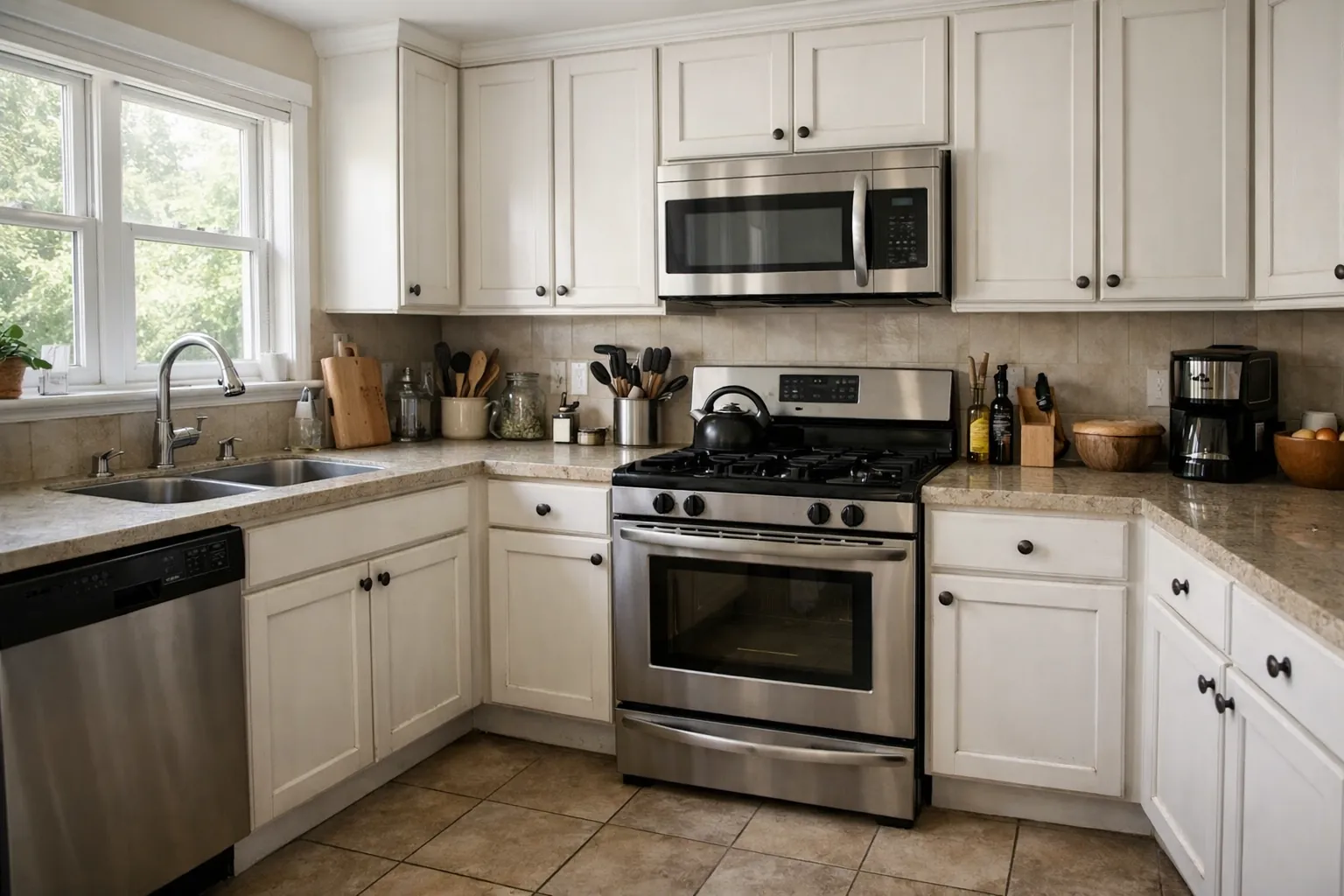
How long do kitchen remodels last? Long enough for the appliances to wear out about twice before the next one. At the 2021 to 2023 pace, a typical owner-occupied US kitchen is remodeled about once every 35 years, according to our analysis of the 2023 American Housing Survey (Census Bureau and HUD microdata). Inside that cycle the parts run on different clocks: the NAHB study of home component life puts kitchen cabinets at 50 years and natural stone counters at a lifetime, while the Department of Energy’s own lifetime estimates put dishwashers at 15.2 years (DOE, 2024) and standard refrigerators at 14.3 (DOE, 2024). So the shell of a remodel (cabinet boxes, stone or tile, the floor) usually outlasts the cycle, and the things with motors, cartridges and finishes do not.
- Low
- $10 years
- Typical remodel cycle
- $35 years
- High
- $50 years
Which part of a kitchen remodel wears out first, part by part
We lined up three published lifespan sets for the same kitchen parts: the NAHB/Bank of America study (owner homes, survey of manufacturers), the Fannie Mae EUL table that lenders use for apartment units (reproduced in Vermont Housing Finance Agency’s capital needs guide), and the Department of Energy’s lifetime estimates from its appliance rulemakings. The last column is our calculation: 35 years (the national remodel cycle from our analysis of the 2023 American Housing Survey) divided by the owner-home life, which tells you how many times that part wears out before a typical kitchen is redone. For appliances we used the DOE figure. Rows run from shortest-lived to longest.
| Part | Owner home (NAHB) | Rental unit (Fannie Mae) | Federal (DOE) | Wear-outs per 35-yr cycle |
|---|---|---|---|---|
| Microwave | 9 yrs | 10 yrs | 10.8 yrs (DOE) | 3.2 |
| Lighting controls, switches | 10+ yrs | Not listed | Not rated | Up to 3.5 |
| Garbage disposer | 12 yrs | Not listed (unit) | Not rated | 2.9 |
| Range hood | 14 yrs | 10 yrs | Not rated | 2.5 |
| Refrigerator, standard | 13 yrs | 10 yrs | 14.3 yrs (DOE) | 2.4 |
| Gas range | 15 yrs | 15 yrs | 14.5 yrs (DOE) | 2.4 |
| Kitchen faucet | 15 yrs | Not listed | Not rated | 2.3 |
| Dishwasher | 9 yrs | 5 to 10 yrs | 15.2 yrs (DOE) | 2.3 |
| Interior paint | 15+ yrs | Not listed | Not rated | Up to 2.3 |
| Electric range | 13 yrs | 15 yrs | 16.8 yrs (DOE) | 2.1 |
| Laminate floor | 15 to 25 yrs | Not listed | Not rated | 1.4 to 2.3 |
| Cultured marble top | 20 yrs | Not listed | Not rated | 1.8 |
| Linoleum floor | 25 yrs | Resilient: 10 yrs | Not rated | 1.4 |
| Enamel steel sink | 5 to 10 yrs | Not listed | Not rated | 3.5 to 7 |
| Kitchen cabinets | 50 yrs | Wood 20, particleboard 15 | Not rated | 0.7 |
| Vinyl floor | 50 yrs | Resilient: 10 yrs | Not rated | 0.7 |
| Modified acrylic sink | 50 yrs | Not listed | Not rated | 0.7 |
| Tile floor | 75 to 100 yrs | 20 yrs | Not rated | 0.35 to 0.47 |
| Natural stone counter | Lifetime | Not listed | Not rated | 0 |
Sources: NAHB/Bank of America Home Equity, Study of Life Expectancy of Home Components (Feb 2007), Table 1; Fannie Mae Estimated Useful Life Tables, Multifamily/Coop column, as attached to VHFA Capital Needs Assessment Guidance (rev. Dec 2015); DOE average lifetimes from 88 FR 39912 (2023), 89 FR 3026 (2024), 89 FR 11434 (2024) and 89 FR 31398 (2024). Cycle column: our calculation, 35 / life in years (DOE for appliances, NAHB otherwise). Accessed 26 Nov 2026.
A kitchen remodel runs on three clocks, and the shortest is about 10 years
Read the table as three groups rather than one number.
- The 10 to 17 year clock: anything with a motor, a compressor, a valve cartridge or a finish you scrub. The microwave (10.8 years), refrigerator (14.3), gas range (14.5), dishwasher (15.2) and electric range (16.8) all sit here in DOE’s estimates (DOE), and NAHB puts the kitchen faucet at 15 years, the disposer at 12 and the range hood at 14 (NAHB). Over a 35-year cycle each of these goes about twice, according to our calculation in the table above.
- The 20 to 25 year clock: softer surfaces. NAHB lists laminate flooring at 15 to 25 years, linoleum at 25 and cultured marble tops at 20 (NAHB). These are the parts that make a 20-year-old kitchen look tired even when everything still works.
- The 50-year-plus clock: the shell. Kitchen cabinets at 50 years, vinyl floors at 50, tile floors at 75 to 100, and natural stone and tile countertops at a lifetime (NAHB). These outlast the remodel cycle, which is why most kitchens are replaced for reasons other than wear.
Two parts the NAHB list does not cover are quartz counters and modern soft-close hardware. Our page on how long quartz countertops last reads eight maker warranties, four of them lifetime, and our page on how long kitchen cabinets last shows why hinges and drawer slides wear out long before the box.
Lenders give a rental kitchen half the life of an owner kitchen
The gap between the two middle columns is the most useful thing in the table if you own a rental or a house with heavy use. The Fannie Mae EUL table books wood kitchen cabinets at 20 years and particleboard cabinets at 15 in a standard apartment unit, against 50 years in the NAHB owner-home survey (NAHB). Ceramic tile floors drop from 75 to 100 years to 20, and resilient flooring from 50 years (NAHB vinyl) to 10.
The Fannie Mae table is a planning tool for when a lender expects to pay for replacement, not a wear test, and it carries its own caveat that consultants should adjust for maintenance, environment and residents (Fannie Mae EUL table). But it is a fair stand-in for a hard-use kitchen: a large family, a kitchen that is also the laundry and homework room, or a home that changes hands often. The same table gives a seniors’ unit 25 years on wood cabinets and a student unit 15 (Fannie Mae EUL table), which tells you use, not age, drives most of the difference.
The 50-year cabinet figure is a 2006 phone survey, so treat it as a ceiling
Every site that quotes a kitchen lifespan, including this one, leans on the same NAHB document. It is worth knowing what it is. In the summer of 2006, NAHB ran a telephone survey of manufacturers, trade associations and researchers, and the report says it “should be used as a general guideline only” (NAHB). The appliance rows came from Appliance Magazine and Grainger and are “based on first-owner use” (NAHB).
The federal appliance figures are newer and they have been moving down. DOE’s estimate for a standard refrigerator fell from 17.4 years in its 2011 rule (DOE, as listed in 88 FR 12452) to 14.3 in 2024 (DOE), and gas cooking products fell from 19 years (DOE, 2009) to 14.5 (DOE, 2024). Our federal appliance lifetime index tracks all 20 types. If you are planning the next 35 years of a kitchen, budget the appliances on the lower, newer numbers.
Style ends more kitchens than broken parts do
The NAHB study says it outright: some components “remain functional but become obsolete due to changing styles and preferences,” and products are often “replaced long before, or after, the end of their practical life expectancy” (NAHB). The federal survey data point the same way. According to our analysis of the 2023 American Housing Survey, homes built 1960 to 1979 are remodeled every 29.2 years and homes built 1980 to 1999 every 30.5, while homes built before 1960 take 36.7 years, possibly because many of the oldest kitchens were already redone once, which the survey cannot test. Homes built since 2010 come out at 98.9 years: their kitchens are simply too new.
So the honest answer to how long a remodel lasts has two parts. Physically, the cabinets and stone can go 50 years or more (NAHB). In practice, the same AHS figures put the pace at one remodel every 29 to 37 years depending on when the home was built, and plenty of owners refresh them sooner by painting or refacing the cabinets instead of replacing them.
A 35-year kitchen, decade by decade
- Step 2
Years 10 to 17
First appliance round
Dishwasher, refrigerator, range, faucet and disposer come due, per the DOE and NAHB figures in the table. A faucet swap is a small job; see our kitchen faucet replacement cost guide.
- Step 3
Years 15 to 25
Surfaces
Paint, laminate or linoleum floors and cultured marble tops reach their NAHB lives (15 to 25 years, NAHB). This is often when a kitchen first looks dated. Our kitchen floor replacement cost page prices the floor on its own.
- Step 4
Years 25 to 35
Second appliance round, then the remodel
A second set of appliances is due, and the national average says the whole kitchen gets redone at about 35 years (our analysis of the 2023 American Housing Survey). Cabinets with sound boxes can be kept and refaced.
Plan the remodel around the parts you will replace
Because the appliances and faucet will be swapped about twice in the life of the remodel (our calculation from the table above), the cheapest long-term kitchen is one where those swaps are easy:
- Keep appliance openings at standard widths so a replacement slides in without cabinet or counter work.
- Put the money into the long-clock parts: cabinet boxes, the countertop and the floor under the cabinets. These are what you would otherwise tear out.
- Keep spec sheets and warranty registrations for every appliance; several quartz warranties need registration within 30 days to 6 months, as our quartz warranty table shows.
- If you have to stage the work, do the long-clock parts first; our guide to remodeling a kitchen in stages sets out the order.
If you meant how long the construction takes
Many people searching this question want to know how long the job itself runs, not how long the result holds up. That is a different answer, driven mostly by cabinet lead times and permit inspections, and our kitchen remodel timeline goes through it phase by phase with sourced durations. Before booking anyone, our guide on how to choose a remodeling contractor covers what to get in writing about the schedule.
Frequently Asked Questions
How long should a kitchen remodel last before it needs redoing?
About 35 years on average: that is how often owner-occupied US kitchens were remodeled at the 2021 to 2023 pace, according to our analysis of the 2023 American Housing Survey. The cabinets and stone can last longer (NAHB lists cabinets at 50 years), but appliances and the faucet will need replacing two or so times in between.
Is $30,000 enough for a kitchen remodel?
For most owners, yes. In our analysis of the 2023 American Housing Survey (Census Bureau and HUD AHS 2023 microdata), the median hired-out kitchen remodel cost $12,000, and among hired-out jobs of $10,000 or more the median was $20,000. A full gut with custom cabinets and moved plumbing can cost more; run your own numbers in our remodel cost calculator.
Is $10,000 enough for a kitchen remodel?
It is close to typical for a partial job. Owners reported a median of $8,000 per kitchen remodel, DIY included, according to our analysis of the 2023 American Housing Survey of Census Bureau and HUD microdata. That usually covers counters, appliances or a cabinet refresh, not new cabinets plus new counters plus a new floor.
What is the 30% rule in remodeling?
There is no single sourced 30% rule; the figure is used in different ways online. The rule repeated most often for kitchens is to spend 5% to 15% of the home’s value, and owners do not follow it: 69.9% of hired-out kitchen remodels cost less than 5% of value, according to our analysis of the 2023 American Housing Survey of Census Bureau and HUD microdata.
What kitchen trends will look outdated in 2026?
Nobody has data that predicts this. What the data does show is that surfaces date first: paint, laminate floors and cultured marble have 15 to 25 year lives in the NAHB study, and NAHB notes parts are often replaced for style before they wear out. Put trend choices on parts that are cheap to change.
Sources
- National Association of Home Builders / Bank of America Home Equity, Study of Life Expectancy of Home Components (2007)
- Fannie Mae, via Vermont Housing Finance Agency, Capital Needs Assessment Guidance, Appendix: Estimated Useful Life (EUL) Tables (rev. Dec 2015) (2015)
- U.S. Census Bureau and HUD, AHS 2023 National Public Use File v1.1 (2025)
- U.S. Department of Energy, Federal Register, Energy Conservation Standards for Dishwashers, direct final rule (89 FR 31398) (2024)
- U.S. Department of Energy, Federal Register, Energy Conservation Standards for Refrigerators, Refrigerator-Freezers and Freezers, direct final rule (89 FR 3026) (2024)
- U.S. Department of Energy, Federal Register, Refrigerators, Refrigerator-Freezers and Freezers, proposed rule (88 FR 12452) (2023)
- U.S. Department of Energy, Federal Register, Energy Conservation Standards for Consumer Conventional Cooking Products, direct final rule (89 FR 11434) (2024)
- U.S. Department of Energy, Federal Register, Energy Conservation Standards for Certain Consumer Products: Dishwashers, Microwave Ovens, Kitchen Ranges and Ovens, final rule (74 FR 16040) (2009)
- U.S. Department of Energy, Federal Register, Energy Conservation Standards for Microwave Ovens, final rule (88 FR 39912) (2023)