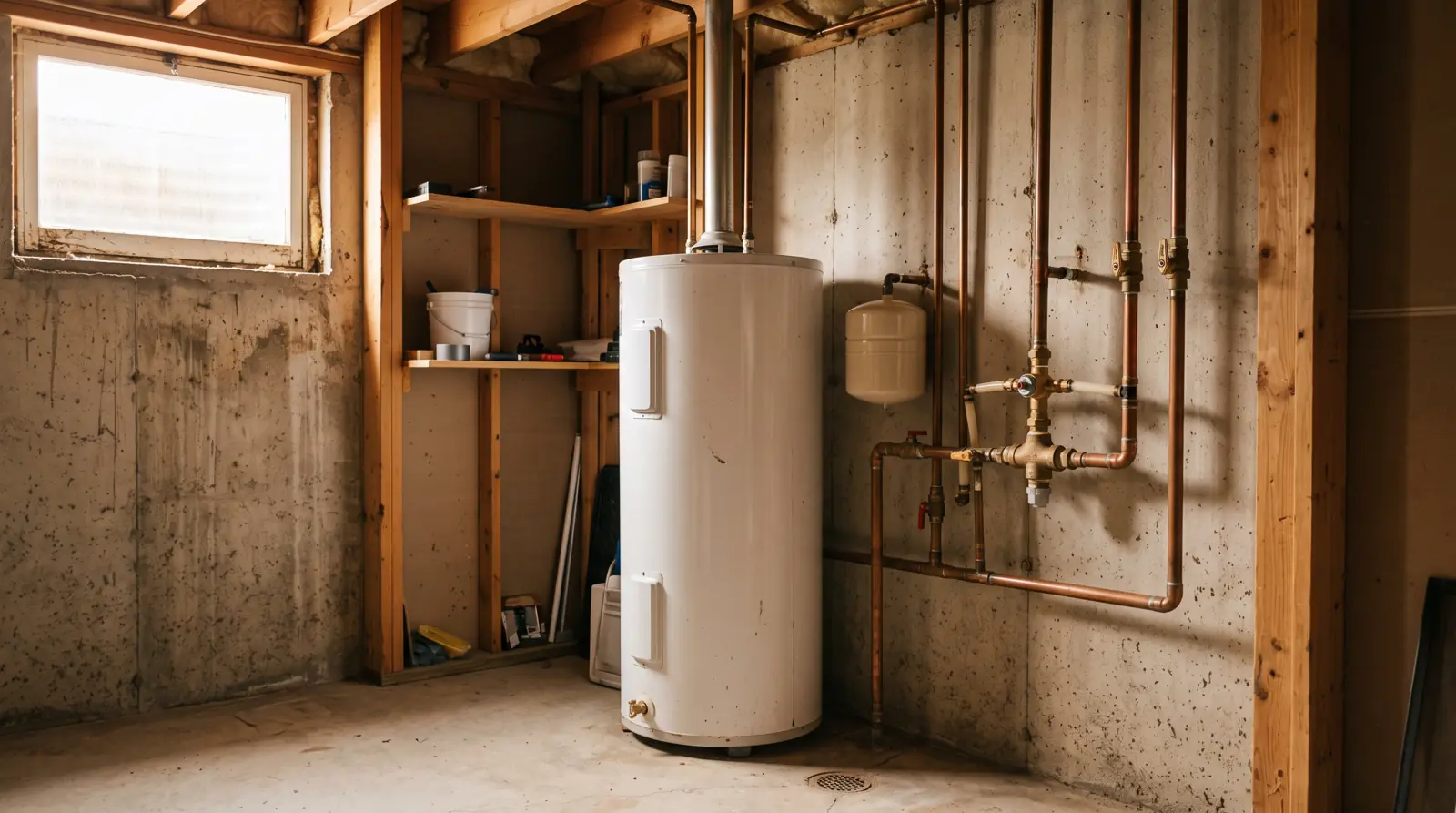
Water Heater Temperature: 120 vs 140 Degrees, Scalds and the Rules
- Primary data
- CPSC NEISS public files 2015 to 2025 (scald cases, case level)
- Data period
- 2015 to 2025
- Latest release used
- 2026 (CPSC posts each calendar year generally in April of the following year; exact date not stated)
- Next release
- NEISS 2026 file, expected around April 2027
- Geography
- United States
- Sources
- 20 (19 Tier 1)
An estimated 3,933 U.S. emergency visits in 2025 were tap, tub, shower or water heater scalds, only 7.4% of hot-water scalds. DOE and CPSC put the water heater temperature at 120 °F, CDC building guidance stores it above 140 °F for Legionella, and mixing valves settle it. Each 10 °F lower saves $9 to $52 a year on electric.
Water heater temperature rules: DOE and CPSC say 120 °F, CDC says store above 140 °F
Federal consumer agencies and a state statute converge on 120 °F at the tap. Federal Legionella guidance for buildings asks for hotter storage. The written rules resolve the conflict with mixing valves, not a single thermostat number.
The U.S. Consumer Product Safety Commission urges households to lower water heaters to 120 °F (CPSC Publication 5098). The U.S. Department of Energy's 2022 Energy Saver Guide gives the same 120 °F figure and calls it safe for most of the population (DOE, 2022).
The Centers for Disease Control and Prevention tells building water managers to store hot water above 140 °F and to keep circulating hot water from falling below 120 °F (CDC Legionella Control Toolkit). The same CDC page recommends thermostatic mixing valves as close as possible to fixtures, so storage can stay hot while the tap stays safe.
Washington State has required since 1983 that new residential water heaters be preset at no more than 120 °F, and that landlords reset individual heaters to no more than 120 °F for each new tenant (RCW 19.27A.060). The statute allows a hotter tank when mixing valves hold delivered water to 120 °F.
| Body | Rule or recommendation | Temperature named | Type | Source |
|---|---|---|---|---|
| CPSC | Lower water heaters to 120 °F | 120 °F | Federal recommendation | Publication 5098 |
| DOE Energy Saver | Set water heater to 120 °F | 120 °F | Federal recommendation | Energy Saver Guide 2022 |
| DOE FEMP | 120 °F for most residential uses; DoD storage at least 140 °F with tempering valve set to 120 °F | 120 °F; 140 °F | Federal purchasing guidance | FEMP water heater page |
| Washington State | New water heaters preset at no more than 120 °F; reset to no more than 120 °F at each new tenancy | 120 °F | State statute (1983) | RCW 19.27A.060 |
| Minnesota (UPC 409.4 as amended) | Bathtub and whirlpool filler limited to 120 °F by ASSE 1070 or CSA B125.3 device or ASSE 1084 heater | 120 °F | State plumbing code | Minn. R. 4714.0409 |
| Model plumbing codes (per ASSE) | ASSE 1016 compensating shower valves with limit stop; heater thermostat not the final control | Number not verified | Model code summary | ASSE white paper 2013 |
| CDC | Store hot water above 140 °F; circulating hot water not below 120 °F; mixing valves near fixtures | 140 °F; 120 °F | Federal guidance (buildings) | Legionella Control Toolkit |
| ASPE (per ASSE) | Storage outlet 135 °F to 140 °F | 135 to 140 °F | Trade position paper (1989) | ASSE white paper 2013 |
Registry of rules opened on 2026-11-02. IPC and UPC shower temperature limits were not verified because the code publishers block automated access; see excluded.md.
Source: [6][7][10][11][12][13][19] U.S. Consumer Product Safety Commission; U.S. Department of Energy; U.S. Department of Energy, Federal Energy Management Program; Washington State Legislature; Minnesota Office of the Revisor of Statutes; Centers for Disease Control and Prevention; ASSE International Scald Awareness Task Group (hosted by IAPMO)
Children under 5 are scalded at the tap at 7.2 times the rate of adults 65 and older
Children under 5 account for 37.2% of tap-water scald visits. Only this age group is large enough to report year by year under CPSC's own sample-size rules.
Across 2021 to 2025, children aged 0 to 4 had an estimated 1,445 tap-water scald ED visits a year, a rate of 7.76 per 100,000 children. Adults 65 and older had 657 a year, or 1.08 per 100,000. The all-ages rate was 1.15 per 100,000.
Tap-water scald ED visits per 100,000 people, 2021 to 2025 average
Source: CPSC NEISS; Census Vintage 2025; KBR analysis
CPSC withholds any NEISS estimate built on fewer than 20 cases, below 1,200, or with a coefficient of variation above 33% (CPSC). Applied to 66 age-by-year cells, only 11 pass, and 10 of those are the under-5 group.
| Age group | 2015 | 2016 | 2017 | 2018 | 2019 | 2020 | 2021 | 2022 | 2023 | 2024 | 2025 | 2021 to 2025 average | Rate per 100,000 |
|---|---|---|---|---|---|---|---|---|---|---|---|---|---|
| 0 to 4 | 1,277 | suppressed | 1,734 | 1,347 | 2,050 | 1,655 | 1,427 | 1,464 | 1,302 | 1,644 | 1,391 | 1,445 | 7.76 |
| 5 to 14 | suppressed | suppressed | suppressed | suppressed | suppressed | suppressed | suppressed | suppressed | suppressed | suppressed | suppressed | 212 (below 1,200) | 0.52 |
| 15 to 24 | suppressed | suppressed | suppressed | suppressed | suppressed | suppressed | suppressed | suppressed | suppressed | suppressed | suppressed | 193 (below 1,200) | 0.43 |
| 25 to 44 | suppressed | suppressed | suppressed | suppressed | suppressed | suppressed | suppressed | suppressed | suppressed | suppressed | suppressed | 610 (below 1,200) | 0.68 |
| 45 to 64 | suppressed | suppressed | suppressed | suppressed | suppressed | suppressed | suppressed | suppressed | suppressed | 1,218 | suppressed | 773 (below 1,200) | 0.94 |
| 65+ | suppressed | suppressed | suppressed | suppressed | suppressed | suppressed | suppressed | suppressed | suppressed | suppressed | suppressed | 657 (below 1,200) | 1.08 |
Cells marked 'suppressed' fail at least one CPSC rule (fewer than 20 cases, estimate under 1,200, or CV over 33%). Rates use the mean July 1 population for 2021 to 2025. Averages below 1,200 a year are shown but labelled.
Source: [1][4][18] U.S. Consumer Product Safety Commission; U.S. Consumer Product Safety Commission; U.S. Census Bureau
Tap scalds are more often serious than container scalds. From 2021 to 2025, 37.0% of tap-water scald patients were hospitalized (transferred, admitted or held for observation), against 14.1% for scalds from pots, kettles and cups. For patients 65 and older the tap figure was 51.7%.
At 140 °F a third-degree burn takes 6 seconds; at 120 °F it takes 5 minutes
Every 10 °F above 120 °F cuts the time to a serious burn sharply. CPSC's figures and the 1947 laboratory study behind them differ in detail but agree on the shape.
CPSC states that most adults suffer third-degree burns after 2 seconds in 150 °F water, 6 seconds at 140 °F and 30 seconds at 130 °F, and that 5 minutes at 120 °F could still cause a third-degree burn (CPSC 5098). Exposure time at 120 °F is 50 times longer than at 140 °F.
Adult skin, CPSC Publication 5098
Source: U.S. CPSC, Avoiding Tap Water Scalds
The ASSE International Scald Awareness Task Group reproduces the Moritz and Henriques burn study (American Journal of Pathology, 1947): a permanent second-degree burn takes 9 minutes at 120 °F, 5 seconds at 140 °F and 1 second at 154 °F (ASSE white paper, 2013).
| Water temperature | CPSC: third-degree burn | Moritz and Henriques: first-degree | Moritz and Henriques: permanent second-degree |
|---|---|---|---|
| 120 °F (49 °C) | 5 minutes | 3 minutes | 9 minutes |
| 122 °F (50 °C) | not given | 1 minute | 5 minutes |
| 126 °F (52 °C) | not given | 30 seconds | 90 seconds |
| 130 °F | 30 seconds | not given | not given |
| 131 °F (55 °C) | not given | 5 seconds | 25 seconds |
| 140 °F (60 °C) | 6 seconds | 2 seconds | 5 seconds |
| 149 °F (65 °C) | not given | 1 second | 2 seconds |
| 150 °F | 2 seconds | not given | not given |
| 154 °F (68 °C) | not given | instantaneous | 1 second |
CPSC column from Publication 5098. Moritz and Henriques columns as reproduced in ASSE Table 1 (1947 study; original paper not opened). The two sources use different burn definitions and do not agree exactly.
Source: [6][19] U.S. Consumer Product Safety Commission; ASSE International Scald Awareness Task Group (hosted by IAPMO)
The ASSE paper also warns that a tank set to 120 °F can deliver water above 140 °F at the top of the tank after many short draws, a condition called stacking. That is the case for a limiting device at the fixture rather than relying on the tank thermostat.
Minnesota's plumbing code caps the tub filler at 120 °F and lets the tank run hotter behind a valve
Plumbing rules aim at the outlet, not the tank. A remodel that replaces a tub or shower valve is where these limits apply.
Minnesota's plumbing code, which amends the Uniform Plumbing Code section 409.4, limits hot water from a bathtub or whirlpool filler to 120 °F, using an ASSE 1070 or CSA B125.3 limiting device or an ASSE 1084 water heater (Minn. R. 4714.0409).
According to ASSE, most model plumbing codes require ASSE 1016 automatic compensating shower valves with a maximum temperature limit stop, and bar the water heater thermostat from serving as the final temperature control (ASSE, 2013). ASSE cites a 1989 plumbing engineers' position for 135 °F to 140 °F storage to limit bacteria.
The Federal Energy Management Program notes that Department of Defense criteria require storage at no less than 140 °F with a tempering valve set to 120 °F for residential use (DOE FEMP). These outlet limits come into play whenever a tub or shower valve is replaced, as in a bathroom remodel or a walk-in shower project.
| Temperature | What happens to Legionella | Source |
|---|---|---|
| 68 °F (20 °C) | Lower edge of growth range; dormant below | ASSE Figure 1; CDC |
| 77 to 113 °F | Favorable growth range | CDC |
| 95 to 115 °F | Ideal growth range | ASSE Figure 1 |
| 120 °F | CDC floor for circulating hot water | CDC |
| 122 °F (50 °C) | Survive but do not multiply (laboratory) | ASSE Figure 1 |
| 131 °F (55 °C) | Die within 5 to 6 hours | ASSE Figure 1 |
| 140 °F (60 °C) | Die within 32 minutes; CDC storage floor | ASSE Figure 1; CDC |
| 151 °F (66 °C) | Die within 2 minutes | ASSE Figure 1 |
Laboratory thresholds from ASSE Figure 1 (after Freije) and CDC building guidance. Real systems with scale and biofilm can grow Legionella above 122 °F.
Source: [13][19] Centers for Disease Control and Prevention; ASSE International Scald Awareness Task Group (hosted by IAPMO)
Each 10 °F lower is worth $9.37 to $51.55 a year on an electric heater
DOE gives a savings range for going from 140 °F to 120 °F. Applied to measured household water-heating use and 2025 prices, the range is modest for gas and wider for electric.
DOE says turning a heater down from 140 °F to 120 °F saves 4% to 22% of water-heating energy a year, and that a heater set at 140 °F can waste $36 to $61 a year in standby losses (DOE, archived official page).
Households whose main water heater is electric used 2,719.8 kWh for water heating in 2020 (EIA RECS 2020). At the 2025 U.S. residential price of 17.23 cents per kWh, that is $468.62 a year. Gas households used 18.10 thousand cubic feet, or $277.65 at $15.34 per Mcf.
DOE 4% to 22% range split per 10 °F, 2025 prices
Source: DOE; EIA RECS 2020 and 2025 prices; KBR analysis
| Fuel | Annual use (RECS 2020) | 2025 price (EIA) | Water-heating bill | Saved per 10 °F, low | Saved per 10 °F, high |
|---|---|---|---|---|---|
| Electric | 2,719.8 kWh | 17.23 cents/kWh | $468.62 | $9.37 | $51.55 |
| Natural gas | 18.10 Mcf | $15.34/Mcf | $277.65 | $5.55 | $30.54 |
| DOE standby figure | not given | not given | not given | $18.00 | $30.50 |
DOE says 140 °F to 120 °F saves 4% to 22% a year; the per-10 °F values split that 20 °F range in half. Use from RECS 2020 (households whose main water heater uses that fuel); prices are EIA 2025 annual averages.
Source: [8][15][16][17] U.S. Department of Energy; U.S. Energy Information Administration; U.S. Energy Information Administration; U.S. Energy Information Administration
Splitting the DOE 20 °F range evenly, each 10 °F is worth $9.37 to $51.55 a year for electric and $5.55 to $30.54 for gas. DOE's standby figure alone works out to $18.00 to $30.50 per 10 °F. Heat pump models change the math; see heat pump water heater data, and how long a water heater lasts for replacement timing.
How the scald count was built: 1 diagnosis code, 12 product codes and a narrative screen
Every estimate comes from the 11 NEISS public files for 2015 to 2025, read case by case, with survey weights and design-based standard errors.
- Universe: cases with diagnosis 48 (scald) in either diagnosis field and product 1934 (hot water) or a tap fixture code.
- Tap: any bathtub, shower, enclosure, faucet or water heater code; a sink code with no cooking words; or 1934 with a tap, bath, shower or heater narrative and no cooking, cup or other product evidence.
- Container: no tap evidence and either a cooking or container word, or another product code such as a range, microwave or cookware.
- Not stated: neither rule fires. These are reported separately, never folded into either group.
- Variance: Taylor linearization by stratum and PSU; CPSC's three stability rules applied to every cell; years pooled as independent samples.
The numbers in one list
- Tap, tub, shower and water heater scalds sent an estimated 3,933 people to U.S. emergency departments in 2025 (95% CI 2,919 to 4,946).[1]
- Tap sources made up 7.4% of the 52,917 hot-water scald ED visits in the United States in 2025.[1][2]
- From 2021 to 2025, U.S. hot-water scalds from pots, kettles, cups and bottles averaged 36,171 ED visits a year, 80.3% of the total.[1]
- U.S. children aged 0 to 4 had 1,445 tap-scald ED visits a year in 2021 to 2025, a rate of 7.76 per 100,000.[1][18]
- U.S. adults 65 and older had a tap-scald rate of 1.08 per 100,000 in 2021 to 2025, and 51.7% were transferred, admitted or held.[1][18]
- The bathtub or shower was involved in 65.0% of U.S. tap-water scald ED visits in 2021 to 2025.[1]
- 70.7% of U.S. tap-water scalds in 2021 to 2025 happened at home.[1]
- Only 11 of 66 age-by-year tap-scald cells for 2015 to 2025 meet CPSC's stability rules.[1][4]
- CPSC says 150 °F water causes a third-degree burn in 2 seconds, 140 °F in 6 seconds and 130 °F in 30 seconds; 120 °F takes 5 minutes.[6]
- CDC recommends storing building hot water above 140 °F and keeping circulating hot water at 120 °F or more to control Legionella.[13]
- Washington State has required new residential water heaters to be preset at no more than 120 °F since 1983.[11]
- In Minnesota, plumbing rule 4714.0409 (in force since 2021) limits bathtub and whirlpool filler water to 120 °F.[12]
- At 2025 U.S. prices, a 10 °F lower setting is worth $9.37 to $51.55 a year for an electric water heater.[8][15][17]
- For a natural gas water heater, the same 10 °F is worth $5.55 to $30.54 a year at the 2025 U.S. price of $15.34 per Mcf.[8][16][17]
Calculations
Tap-water scald ED visits (signature finding)
FormulaSum of NEISS Weight over scald cases (diagnosis 48) classified as tap source; variance by stratum and PSU
Inputs: fact rows 1, 6, 7, 8; derived d1 (fact sheet rows)
Result: 3,933 in 2025 (95% CI 2,919 to 4,946); 3,890 a year in 2021 to 2025
Tap scalds are a small, steady slice of all scald ED visits; most hot-water scalds come from water heated for cooking or drinks.
Limitations: Narrative-based classification; the 'not stated' group means the tap count is a lower bound.
Tap share of hot-water scalds
Formulatap weighted total / hot-water universe weighted total
Inputs: derived d1, d2, d4 (fact sheet rows)
Result: 7.4% in 2025; 8.6% in 2021 to 2025; upper bound 19.7%
Turning a water heater down addresses fewer than 1 in 10 hot-water scald ER visits, but tap scalds are more often hospitalized than scalds from pots and kettles.
Limitations: The universe excludes scalds from hot food and drinks, which NEISS codes elsewhere.
Age rates with CPSC suppression
Formulaannual average tap visits by age / mean population x 100,000
Inputs: derived d6, d7, d13; fact row for population (fact sheet rows)
Result: 7.76 per 100,000 under 5; 1.08 at 65+; 11 of 66 annual cells reportable
Under-5 children carry the tap-scald burden; adult groups are too small for annual reporting.
Limitations: Averages for ages 5 to 64 and 65+ fall below CPSC's 1,200 threshold.
Burn-time ratio
FormulaCPSC time at 120 °F / time at 140 °F = 300 / 6
Inputs: fact rows for CPSC burn times (fact sheet rows)
Result: 50 times longer at 120 °F
A 20 °F change turns a seconds-long hazard into a minutes-long one.
Limitations: Adult skin; CPSC does not name its study.
Dollar value per 10 °F
FormulaRECS 2020 use x EIA 2025 price x (4% or 22%) / 2
Inputs: derived d15, d16, d17 (fact sheet rows)
Result: electric $9.37 to $51.55; gas $5.55 to $30.54
The safety change costs nothing and saves a little; the electric range is wider because electricity costs more per unit of heat.
Limitations: Linear split of DOE's 20 °F range is our assumption; DOE gives no price year.
Questions people ask
Is 120 degrees hot enough to kill bacteria?
Not reliably. Laboratory data reproduced by ASSE show Legionella survive without multiplying above 122 °F and die within 32 minutes at 140 °F. DOE calls the risk at 120 °F very slight and safe for most people; CDC asks buildings to store water above 140 °F.
Why is my hot water not hot enough?
DOE notes that thermostat dials are often inaccurate and suggests measuring with a thermometer at the tap farthest from the heater. ASSE adds that a tank thermostat sits near the bottom and does not sense outlet temperature. Capacity is covered in our water heater size report.
What temperature is too hot for a water heater?
CPSC treats anything above 120 °F at the tap as a scald risk: 130 °F burns in 30 seconds, 140 °F in 6 seconds. A tank can run at 140 °F only when a mixing valve limits delivery.
Should I turn down my water heater when on vacation?
DOE attributes most of the savings from a lower setting to reduced standby losses, which continue while a house is empty. CDC building guidance notes Legionella grow best between 77 °F and 113 °F and recommends flushing low-flow piping, which is why a turned-down tank is usually brought back up before use.
Summary
- An estimated 3,933 people went to U.S. emergency departments in 2025 with scalds from tap, tub, shower or water heater water (NEISS).
- That is 7.4% of hot-water scald visits; water heated in pots, kettles and cups caused 80.3% on average in 2021 to 2025.
- Children under 5 had 37.2% of tap scalds and a rate of 7.76 per 100,000, 7.2 times the 65+ rate.
- 37.0% of tap-scald patients were transferred, admitted or held, 2.6 times the container-scald share.
- CPSC and DOE recommend 120 °F; CDC asks buildings to store hot water above 140 °F and use mixing valves at fixtures.
- Washington law requires new heaters to be preset at no more than 120 °F; Minnesota's plumbing code caps bathtub fillers at 120 °F.
- Each 10 °F lower is worth $9.37 to $51.55 a year on electric and $5.55 to $30.54 on gas at 2025 prices.
Frequently asked questions
What temperature should a water heater be set to?
CPSC and DOE recommend 120 °F. CDC recommends storage above 140 °F in buildings, with mixing valves at fixtures to hold delivered water near 120 °F.
How many people are scalded by hot tap water each year?
An estimated 3,890 a year visited U.S. emergency departments for tap, tub, shower or water heater scalds in 2021 to 2025, and 3,933 in 2025 (CPSC NEISS).
Who is most at risk of tap-water scalds?
Children under 5: 37.2% of tap-scald ED visits and a rate of 7.76 per 100,000, against 1.08 for adults 65 and older.
How fast does 140 degree water burn?
CPSC says a third-degree burn takes 6 seconds at 140 °F. The 1947 Moritz and Henriques data put a permanent second-degree burn at 5 seconds.
How long does it take 120 degree water to burn?
CPSC says 5 minutes of exposure at 120 °F could cause a third-degree burn; the 1947 study puts a permanent second-degree burn at 9 minutes.
Does turning down a water heater save money?
DOE says going from 140 °F to 120 °F saves 4% to 22% a year. At 2025 prices that is $18.74 to $103.10 for a typical electric heater.
Do any states require water heaters to be set at 120?
Washington State's RCW 19.27A.060 requires new residential heaters to be preset at no more than 120 °F and reset for new tenants. Other state laws exist but were not verified here.
What does the plumbing code say about bathtub water temperature?
Minnesota's version of UPC 409.4 limits bathtub and whirlpool filler water to 120 °F through an ASSE 1070 or CSA B125.3 device or an ASSE 1084 water heater.
What is a thermostatic mixing valve for?
It blends hot and cold water so the outlet stays below a set limit. CDC recommends installing them close to fixtures so storage water can stay above 140 °F.
Do dishwashers need 140 degree water?
DOE says a dishwasher without a booster heater may need 130 °F to 140 °F; models with a booster heater work with a 120 °F setting.
Download the data
Every table in this report is available as a CSV under CC BY 4.0. The fact sheet lists each value with its source URL and access date.
- derived_metrics.csv (CSV)
- fact_sheet.csv (CSV)
- Scald emergency department visits by hot-water source, United States, 2015 to 2025 (CSV)
- Tap-water scald ED visits by age group and year, with CPSC suppression rules applied (CSV)
- How long hot water takes to burn adult skin, by temperature (CSV)
- Who says what about water heater and outlet temperatures (CSV)
- What a 10 °F lower setting is worth a year, by fuel (CSV)
- Legionella and water temperature (CSV)
For journalists and researchers
If you cite only a few, cite these
- Tap-water scald ED visits, United States, 2025: 3,933 (95% CI 2,919 to 4,946).[1]
- Tap share of hot-water scald ED visits, 2025: 7.4%.[1]
- Tap-scald rate, children under 5, 2021 to 2025: 7.76 per 100,000.[1][18]
Most quotable statistics
- An estimated 3,933 Americans went to an emergency department in 2025 with scalds from tap, tub, shower or water heater water.[1]
- Only 7.4% of hot-water scald ER visits in 2025 started at a tap; most began with water heated in a pot, kettle or cup.[1]
- U.S. children under 5 are scalded by tap water at 7.76 per 100,000 a year, 7.2 times the rate for adults 65 and older (2021 to 2025).[1][18]
- 37.0% of tap-water scald patients were transferred, admitted or held, against 14.1% for scalds from pots and kettles (2021 to 2025).[1]
- At 140 °F a third-degree burn takes 6 seconds; at 120 °F it takes 5 minutes (CPSC).[6]
- Each 10 °F lower on an electric water heater is worth $9.37 to $51.55 a year at 2025 prices.[8][15][17]
Press summary
Kitchen and Bath Renovators analyzed every scald case in the federal NEISS emergency department sample for 2015 to 2025. An estimated 3,933 people were treated in U.S. emergency departments in 2025 for scalds from tap, tub, shower or water heater water, or 7.4% of hot-water scald visits; water heated in pots, kettles and cups caused 80.3% on average in 2021 to 2025. Children under 5 had the highest rate, 7.76 per 100,000, and 37.0% of tap-scald patients were transferred, admitted or held. CPSC and DOE recommend 120 °F, the temperature at which CPSC says a third-degree burn takes 5 minutes rather than 6 seconds at 140 °F. CDC guidance for buildings stores water above 140 °F to control Legionella and uses mixing valves at fixtures. At 2025 prices, each 10 °F lower saves $9.37 to $51.55 a year on an electric heater. Data and tables are CC BY 4.0.
Suggested headlines
- Tap water scalded an estimated 3,933 Americans badly enough for the ER in 2025
- Only 7.4% of hot-water scald ER visits start at the tap, federal data show
- Toddlers are scalded by tap water at 7.2 times the rate of seniors
- Six seconds or five minutes: what 20 degrees on a water heater means for skin
- Turning a water heater down 10 degrees saves up to $52 a year on electric
How to cite this report
Kitchen and Bath Renovators. (2026). Water Heater Temperature: 120 vs 140 Degrees, Scalds and the Rules. Retrieved from https://kitchenandbathrenovators.com/research/water-heater-temperature/
Reuse license
Data and tables are licensed CC BY 4.0. Attribution: “Source: Kitchen and Bath Renovators, Water Heater Temperature: 120 vs 140 Degrees, Scalds and the Rules” with a link to this page.
Reproduce this analysis
Every figure comes from the files below. The scripts that pulled and computed them are kept with the report and can be re-run.
| Dataset | Publisher | Source | Query or filter | Rows used | Retrieved |
|---|---|---|---|---|---|
| NEISS public data files 2015 to 2025 | U.S. Consumer Product Safety Commission | File or endpoint | Diagnosis or Diagnosis_2 = 48; products 1934, 611, 609, 610, 4030, 699, 648, 118, 119, 133, 134, 236; classification in scripts/scald_defs.py; Weight; Stratum and PSU for variance | 410,201 records in 2025; 2,655 scald cases in 2025; 6,825 hot-water scald cases in 2021 to 2025, of which 710 tap | 2026-11-02 |
| RECS 2020 public microdata v7 | U.S. Energy Information Administration | File or endpoint | FUELH2O = 5 for KWHWTH; FUELH2O = 1 for CUFEETNGWTH / 10; NWEIGHT and NWEIGHT1 to NWEIGHT60 | 18,496 records; 8,310 electric and 8,728 natural gas main water heaters | 2026-11-02 |
| Electric Power Monthly Table 5.3 | U.S. Energy Information Administration | File or endpoint | Annual totals, Residential, 2025 | 1 value | 2026-11-02 |
| U.S. Price of Natural Gas Delivered to Residential Consumers, annual | U.S. Energy Information Administration | File or endpoint | Data 1, 2025 | 1 value | 2026-11-02 |
| Vintage 2025 national population by age and sex | U.S. Census Bureau | File or endpoint | SEX = 0; AGE 0 to 100 (999 dropped); POPESTIMATE2021 to POPESTIMATE2025 averaged | 101 age rows | 2026-11-02 |
Data quality and exclusions
- Of 2,655 scald cases in the 2025 NEISS file, 1,175 had no hot-water or tap-fixture code and were excluded as other scalds (food, drinks, oil, steam devices).
- Sink-coded cases with cooking words (for example draining pasta) were moved from tap to container: 10 to 27 sample cases a year.
- Cases with no tap or container evidence (4,977 a year on average in 2021 to 2025) were kept as a separate 'not stated' class rather than allocated.
- Ages coded 200 and above (under 2 years, in months) were converted to age 0 or 1 year groups as age 0 to 4.
- RECS households with propane, fuel oil, wood, solar or no water heater (5.8% of households) were excluded from the cost baseline.
- Age-by-year cells failing CPSC's rules are printed as 'suppressed': 55 of 66 cells.
Methodology
Source selection: federal data first (CPSC NEISS microdata, EIA RECS microdata and price series, Census population estimates), then federal guidance (CPSC, DOE, CDC), then official state statute and rule text. One trade-body white paper (ASSE) is used for model-code summaries and for its reproduction of the 1947 burn study.
Inclusion: NEISS cases with diagnosis 48 (scald) in either diagnosis field and a hot-water or tap-fixture product code, 2015 to 2025, all locations. Exclusion: scalds from hot food, coffee and other prepared liquids, which NEISS codes to the food or appliance, not to hot water.
Classification: narratives were screened with keyword rules (scripts/scald_defs.py). A manual check of 110 cases from 2021 to 2025 found 47 of 50 tap cases correct, 30 of 30 container cases correctly not tap, and 2 of 30 'not stated' cases with tap evidence.
Conflicts: CPSC and the Moritz and Henriques data give different burn times because they measure different burn depths; both are shown with their definitions. DOE's 4% to 22% range is shown as published; our per-10 °F split is labelled as an assumption.
Derived metrics: weighted totals with Taylor-linearized variance by stratum and PSU, ratio variances linearized, pooled years averaged with independent variances. RECS means use NWEIGHT with Fay's BRR replicate standard errors.
Limitations: NEISS covers emergency department visits only, not urgent care, burn-center direct admissions or deaths. Narratives are short and some name no source.
Last updated 2026-11-02. NEISS data checked against the CPSC archive on that date; the 2025 file is the latest.
This report presents published data with its limitations. It is not legal, financial or investment advice.
Sources, ranked by quality
Tier 1: primary and official sources (19)
- [1] U.S. Consumer Product Safety Commission. NEISS public data files 2015 to 2025 (tab-delimited, one file per year; 2025 shown). Treatment years 2015 to 2025. Accessed 2026-11-02.
- [2] U.S. Consumer Product Safety Commission. NEISS Coding Manual (CPSC only, non-trauma), January 2025 rev. 1. 2025. Accessed 2026-11-02.
- [3] U.S. Consumer Product Safety Commission. NEISS format file (code labels for products and diagnoses). Current. Accessed 2026-11-02.
- [4] U.S. Consumer Product Safety Commission. Explanation of NEISS Estimates Obtained Through the CPSC Website. Current. Accessed 2026-11-02.
- [5] U.S. Consumer Product Safety Commission. NEISS: Frequently Asked Questions. Current. Accessed 2026-11-02.
- [6] U.S. Consumer Product Safety Commission. Avoiding Tap Water Scalds (Publication 5098). Fact sheet, print code dated March 2012. Accessed 2026-11-02.
- [7] U.S. Department of Energy. Energy Saver Guide: Tips on Saving Money and Energy at Home (2022). Published August 2022. Accessed 2026-11-02.
- [8] U.S. Department of Energy. Do-It-Yourself Savings Project: Lower Water Heating Temperature (Internet Archive capture of the official page, 2026-01-01; live page now returns 404). Page dated March 12, 2025. Accessed 2026-11-02.
- [9] U.S. Department of Energy. Water Heating (Internet Archive capture of the official Energy Saver page, 2026-01-01). Captured 2026-01-01. Accessed 2026-11-02.
- [10] U.S. Department of Energy, Federal Energy Management Program. Purchasing Energy-Efficient Residential Water Heaters. Current. Accessed 2026-11-02.
- [11] Washington State Legislature. RCW 19.27A.060 Hot water heaters, temperature regulation. Enacted 1983 c 178; recodified 1985. Accessed 2026-11-02.
- [12] Minnesota Office of the Revisor of Statutes. Minnesota Rules 4714.0409 Bathtubs and whirlpool bathtubs (amends UPC 409.4). Published September 27, 2021. Accessed 2026-11-02.
- [13] Centers for Disease Control and Prevention. Controlling Legionella in Potable Water Systems (Legionella Control Toolkit module). Current. Accessed 2026-11-02.
- [14] Centers for Disease Control and Prevention. About Legionnaires' Disease. Current. Accessed 2026-11-02.
- [15] U.S. Energy Information Administration. Electric Power Monthly Table 5.3, Average Price of Electricity to Ultimate Customers. Annual 2025; release with data through August 2026. Accessed 2026-11-02.
- [16] U.S. Energy Information Administration. U.S. Price of Natural Gas Delivered to Residential Consumers, annual. Annual 2025; file dated 2026-10-28. Accessed 2026-11-02.
- [17] U.S. Energy Information Administration. Residential Energy Consumption Survey 2020 public microdata v7 and codebook. Calendar year 2020. Accessed 2026-11-02.
- [18] U.S. Census Bureau. Vintage 2025 national population estimates by single year of age and sex. July 1, 2021 to July 1, 2025. Accessed 2026-11-02.
- [20] U.S. Energy Information Administration. Electric Power Monthly Table 5.6.A, Average Price of Electricity by State. August 2026 and August 2025. Accessed 2026-11-02.
Tier 2: trade bodies, market research, company data (1)
- [19] ASSE International Scald Awareness Task Group (hosted by IAPMO). Understanding Potential Water Heater Scald Hazards, white paper (revised May 2013). Revised May 2013; burn table from Moritz and Henriques 1947. Accessed 2026-11-02.