Bathroom costs
Cost to Replace a Bathroom Exhaust Fan: Swap, Upsize or New Duct
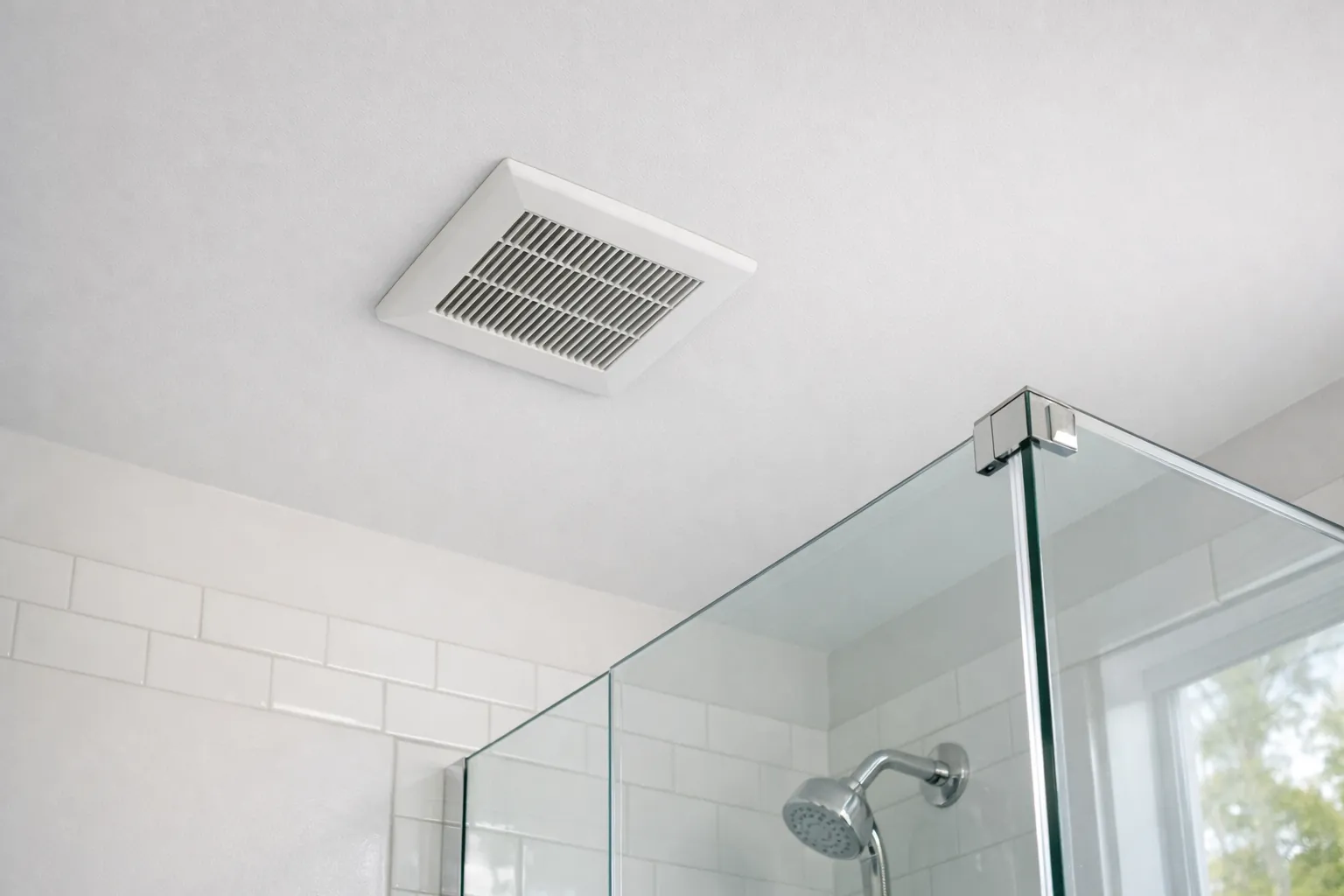
The cost to replace a bathroom exhaust fan is $191 to $411 per fan when the new unit goes into the old hole on the old duct and wiring, per Homewyse‘s May 2026 national estimate; a first-time install with a new hole and a new duct to the outside runs $343 to $889 (Homewyse). Which of those two bills you get depends on two measurements you can take before calling anyone: the size of the metal housing above the grille and the diameter of the duct on it. An old 50 CFM builder fan sits in a box about 7.5 by 7.25 inches on a 3-inch duct, and of the 913 bathroom fans on the ENERGY STAR certified list for the U.S. market, only 60 (6.6%) take a 3-inch duct (our count, list downloaded November 25, 2026).
- Low
- $191 per fan, same-hole replacement
- Midpoint
- $301 per fan, same-hole replacement
- High
- $411 per fan, same-hole replacement
Three different jobs get quoted as a fan replacement
Contractors and cost sites use one phrase for three jobs with very different labor. Sort yours before you compare quotes. A swap reuses the housing hole, duct and switch; an upsize cuts a bigger hole and usually changes the duct collar; a new duct run means attic or wall work and a new roof or wall cap.
| Job | What changes | Typical price | Whose figure |
|---|---|---|---|
| Same-hole swap | Fan only; housing, duct, wiring reused | $191 to $411 per fan | Homewyse, May 2026 |
| Same-hole swap | Same, contractor quote | $150 to $500, about $200 average | Fixr, Feb 2025 |
| Upsize, DIY | Bigger ceiling cutout, new housing | About $429, 2 hours | This Old House, June 2026 |
| New hole and duct | Cut, wire, duct to a vent cap | $343 to $889 per fan | Homewyse, May 2026 |
| New ceiling fan | Install where none exists | $400 to $900 | Fixr, Feb 2025 |
Sources: Homewyse replace and install calculators (May 2026); Fixr (updated Feb 7, 2025); This Old House (updated June 3, 2026). Homewyse excludes permits, sales tax and repairs to framing or wiring.
What the $191 to $411 swap price covers, and what it does not
Homewyse prices the swap as basic labor: shut off power, remove the old unit, mount and wire the new one, and test it, plus fittings, fasteners, small-job setup and debris disposal, with a 2-hour minimum labor charge. It excludes framing or finish repairs, electrical code upgrades, permit and inspection fees and sales tax, and it says to add 13% to 22% if a general contractor supervises the work.
Fixr splits its replacement figure the same way: labor averages about $150 (range $150 to $250) for a replacement against about $300 ($250 to $500) for a first-time install, and a basic fan runs $50 to $75 in materials. So on a plain swap, labor is most of the bill. The fan itself only takes over when you buy a premium unit: in our price table below the spread runs from $32.49 to $189.00, a difference of about $157 (our calculation), which is roughly the same as Fixr’s whole replacement labor figure.
Labor is where local rates bite. Electricians earned a median $30.38 an hour in May 2025, per BLS OEWS national estimates; that is the wage paid, not the rate billed, which carries overhead, travel and the minimum charge. Our electrician shortage report shows why short jobs like this are the first to get padded minimums when demand from bigger projects is high.
Nine replacement fans: price, delivered airflow and housing size
Prices are the seller’s posted price on November 25, 2026 (“list” where the seller shows only a retail price before checkout); they move often. CFM is the rated airflow, then the airflow at 0.25 inches of static pressure, a closer stand-in for a real duct run, both from the ENERGY STAR certified ventilating fans list, which is also our source for sones and duct size. Every fan here is ENERGY STAR certified. Housing sizes are from the seller pages. Choosing a CFM number is a separate question; our bathroom exhaust fan CFM research covers sizing rules and how much airflow certified fans lose in a real duct.
| Fan | Price, seller | CFM rated / at 0.25 in. | Sones | Duct; housing |
|---|---|---|---|---|
| Broan 688E (economy) | $32.49, WebstaurantStore | 50 / 36.5 | 2.0 | 3 in.; housing 7.5 x 7.25 in. |
| Broan AE80B (Flex) | $84.00 list, WebstaurantStore | 80 / 60.5 | 0.7 | 4 in.; housing 10 x 9.25 in. |
| Broan AE110K (Flex) | $164.99, WebstaurantStore | 110 / 95.5 | 1.0 | 4 in.; housing 10 x 9.25 in. |
| Broan AE50110DC (Flex DC) | $161.00 list, WebstaurantStore | 110 / 112.1 | 0.1 to 1.0 | 4 in.; housing 10 x 9.25 in. |
| Panasonic FV-0510VS1 (WhisperValue) | $120.69, Staples | 100 / 102.9 | 0.0 to 0.9 | 4 in. oval duct |
| Panasonic FV-0511VF1 (WhisperFit) | $175.99, Staples | 110 / 96.6 (3 in.), 112.9 (4 in.) | 0.1 to 2.0 (3 in.) | 3 or 4 in.; 5-5/8 in. deep |
| Panasonic FV-0511VQ1 (WhisperCeiling DC) | $172.15, Faucet Depot | 110 / 114.7 | 0.1 to 0.3 | 4 or 6 in.; 10-1/2 in. opening |
| Delta GBR80HLED (BreezGreenBuilder) | $133.00, HVACDirect | 80 / 64.4 | 0.5 to 0.8 | 4 in.; housing 10-3/4 in. square |
| Delta SIG80-110LED (BreezSignature) | $189.00, HVACDirect | 110 / 108.0 (4 in.) | 0.3 to 1.0 (4 in.) | 4 or 6 in.; housing 12-3/8 in. square |
Sources: prices from WebstaurantStore, Staples, Faucet Depot and HVACDirect product pages, accessed 2026-11-25; airflow, sones and duct from the U.S. EPA ENERGY STAR Certified Ventilating Fans dataset, downloaded 2026-11-25. Where ENERGY STAR lists a model at two duct sizes, the 4-inch row is shown unless noted.
The metal box above the grille decides which bill you get
Take the grille off (most pull down on two wire springs) and measure the housing. If the new fan’s housing fits that opening, the job stays a swap. If it does not, someone cuts drywall, finds a joist to fasten to and patches whatever is left over, which is the job This Old House describes: trace the new housing on the ceiling, cut, align one lip with a joist, and add support or patch if the hole ends up too big.
The size jump from an economy fan is real. The Broan 688E housing is 7.5 by 7.25 inches, or about 54 square inches; the Broan Flex housing used by the AE80B, AE110K and AE50110DC is 10 by 9.25 inches, about 93 square inches, so the cutout grows about 70% (our calculation from the WebstaurantStore spec pages). The Delta BreezGreenBuilder housing is 10-3/4 inches square and the BreezSignature 12-3/8 inches square, per HVACDirect.
Makers know this, and a few fans are sold for the swap case. WebstaurantStore’s AE110K page says a SnapFit flange kit is included for a new fan or retrofit upgrade and that the fan installs from the room side without attic access; Staples describes the Panasonic WhisperFit as an ideal retrofit with a 5-5/8 inch housing depth that fits 2x6 joists. Read the fit claims against your own measurements, not the box art.
A 3-inch duct leaves 60 certified fans to choose from
Older economy fans like the 688 series use a 3-inch round duct collar. Most current fans use 4 inches. We counted duct sizes across the 913 bathroom and utility room fans marked for the U.S. market on the ENERGY STAR list: 626 have a 4-inch collar, 210 a 6-inch, and 60 a 3-inch (our calculation, 6.6% of the list). Of those 60, 34 still move 50 CFM or more at 0.25 inches of static pressure, and 13 are rated 80 CFM or more.
That leaves you two paths. Stay on 3-inch and choose from that short list, or move to 4-inch, which means either a 3-to-4 inch adapter at the collar or replacing the duct run. The U.S. Department of Energy’s Building America Solution Center guide says to use the duct diameter the fan maker specifies, keep the first three feet straight, prefer smooth rigid duct over flex, and take the most direct route outside with as few bends as possible. A larger fan on a small, long duct delivers much less than its label.
If the old fan blows into the attic, the swap price no longer applies
The DOE Building America guide says a bathroom fan should vent outdoors, not into an attic, crawlspace, the space between floors, a garage or a wall cavity, and that a retrofit fan exhausting into one of those spaces needs the duct replaced or rerouted to the outside. It also asks for a damper at the wall cap, an outlet at least 10 feet from any mechanical air inlet or 3 feet from a gravity inlet, and exhaust not aimed at a walkway.
Check before you buy: in the attic, follow the duct from the fan. If it ends loose in the insulation, price the job as a new duct run (the Homewyse $343 to $889 install range is the closer guide) and expect a roof or wall cap. The same guide suggests a cheaper first step if the fan just seems weak: vacuum the grille and blades and clear debris from the outside termination before replacing anything.
Four checks that turn a vague quote into a fixed one
- Step 1
Measure the housing
Grille off, tape on the metal box. Compare it to the housing size on the spec sheet of the fan you want; the table above lists nine.
- Step 2
Read the duct collar
3-inch or 4-inch round, or a 4-inch oval. If 3-inch, decide between the short list of 3-inch fans and a duct change.
- Step 3
Find where it ends
Roof cap, wall cap, soffit, or loose in the attic. Loose in the attic means a new duct run, per the DOE guide above.
- Step 4
Check the switch and circuit
A plain fan reuses the existing cable. A fan with a light, heater or sensor may need another switch leg or a separate circuit; ask for that line item in writing.
When a homeowner can do it and when to call an electrician
Fixr says a straight replacement is a reasonable DIY job if you can change a light fixture: turn the breaker off, confirm dead wires with a non-contact voltage tester, and connect like to like. This Old House rates its bigger-fan upgrade 1 out of 5 for difficulty, “easy, if no rewiring is involved”, and says to call an electrician otherwise. It also notes that fans listed for installation directly over a tub or shower must go on a GFCI-protected circuit; our GFCI requirements guide covers where bathrooms need that protection.
Permit rules vary by city, and a new circuit or a new opening is more likely to need one than a like-for-like swap; see what common remodels pay in our building permit cost data, and ask your local building department before work starts. This is not electrical or legal advice.
The cheapest labor is labor already on site. If the fan is part of a bigger refresh, such as a vanity replacement with a new light above it or a full small bathroom remodel, the electrician’s minimum charge is already paid, and the ceiling patch can be painted with everything else. When you compare bids, ask each one to name the job type from the table at the top of this page; our guide to choosing a remodeling contractor covers what else to get in writing.
Frequently Asked Questions
What does it cost to replace a bathroom exhaust fan?
Do I need an electrician to replace a bathroom exhaust fan?
Not always. Fixr calls a like-for-like swap DIY-friendly for anyone who can change a light fixture, but says new wiring typically requires an electrician. A new circuit, a fan over a tub or shower that needs GFCI protection, or a city permit requirement are the usual reasons to hire one.
What is the lifespan of a bathroom exhaust fan?
Makers do not publish a service life, so the warranty is the best written signal. Panasonic’s WhisperValue carries a 6-year motor and 3-year parts warranty, per Staples, and Delta Breez fans carry a 3-year limited warranty, per HVACDirect. Before replacing a fan that still runs, the DOE guide suggests cleaning the grille, blades and outside cap.
Can I replace my own bathroom exhaust fan?
Yes, if the new housing fits the old opening and you reuse the wiring. Turn off the breaker, test the wires, and match black to black, white to white and ground to bare copper, as This Old House describes. Enlarging the ceiling hole is still a DIY job; rewiring is where it rates the job for an electrician.
Will a new fan fit my old 3-inch duct?
Only some will. Of 913 U.S.-market bathroom fans on the ENERGY STAR certified list, 60 take a 3-inch duct (our count, November 25, 2026). The rest need an adapter or a new 4-inch or 6-inch duct.
Sources
- Homewyse, Cost to Replace Bathroom Fan, 2026 Cost Calculator (2026)
- Homewyse, Cost to Install Bathroom Fan, 2026 Cost Calculator (2026)
- Fixr, How Much Does It Cost to Install a Bathroom Exhaust Fan? (2025-02-07)
- This Old House, How to Upgrade to a Bigger Bath Fan (2026-06-03)
- U.S. EPA ENERGY STAR, ENERGY STAR Certified Ventilating Fans (dataset 8dv7-nngq) (2026)
- U.S. DOE / PNNL, Bathroom Exhaust Fans, Building America Solution Center (current)
- U.S. Bureau of Labor Statistics, OEWS May 2025 national estimates, Electricians (47-2111) (2026)
- WebstaurantStore, Broan Economy Series Bathroom Ventilation Fan 688E (current)
- WebstaurantStore, Broan Flex Series Bathroom Ventilation Fan AE80B (current)
- WebstaurantStore, Broan Flex Series Bathroom Exhaust Fan AE110K (current)
- WebstaurantStore, Broan Flex DC Series Bathroom Exhaust Fan AE50110DC (current)
- Staples, Panasonic WhisperValue FV-0510VS1 (current)
- Staples, Panasonic WhisperFit FV-0511VF1 (current)
- Faucet Depot, Panasonic FV-0511VQ1 WhisperCeiling DC SmartFlow (current)
- HVACDirect, Delta BreezGreenBuilder GBR80HLED (current)
- HVACDirect, Delta BreezSignature SIG80-110LED (current)