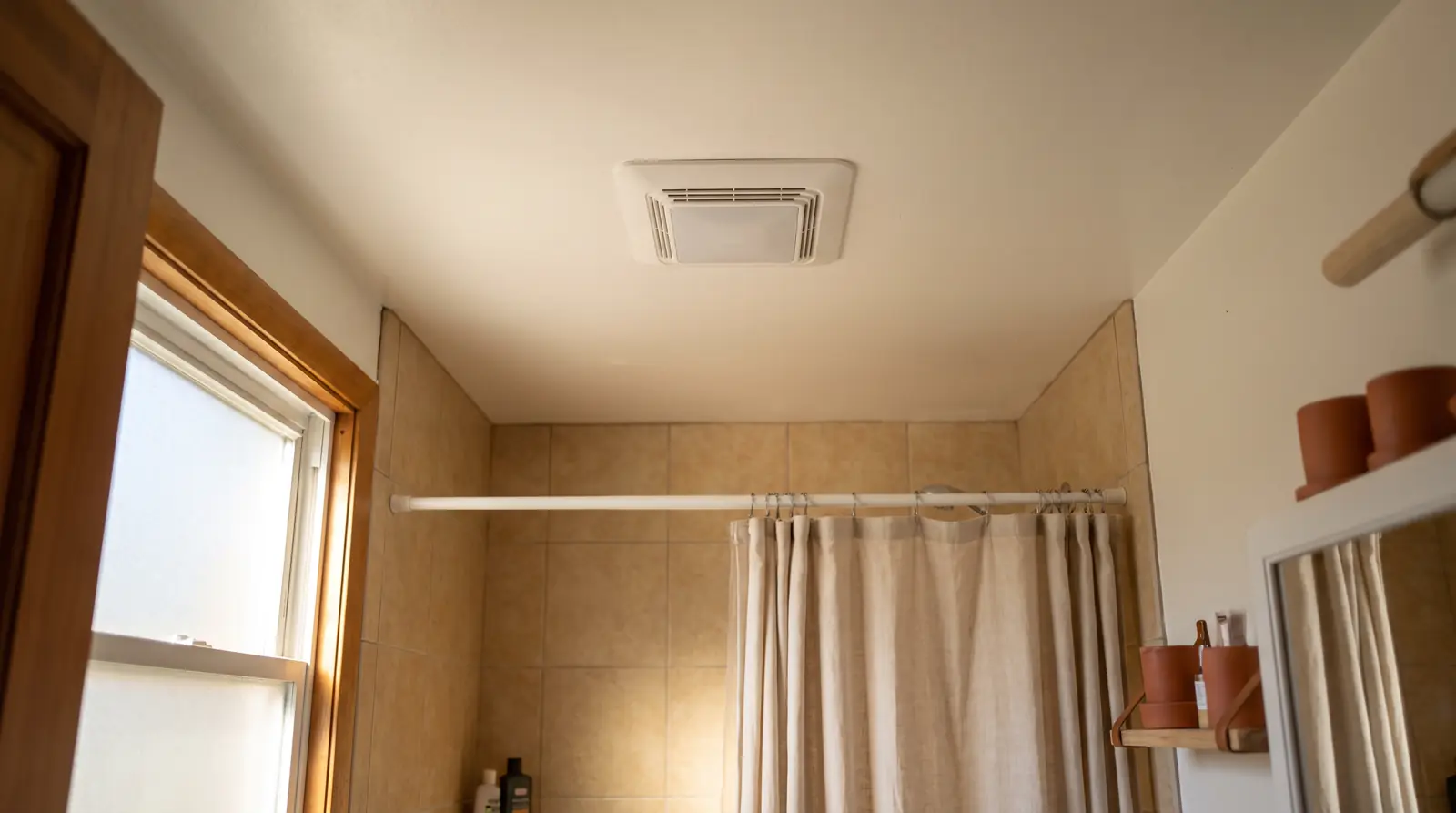
Bathroom Exhaust Fan CFM: Sizing Rules and What Certified Fans Deliver
- Primary data
- ENERGY STAR Certified Ventilating Fans (data.energystar.gov 8dv7-nngq), bathroom/utility room fans; AHS 2023 national PUF
- Data period
- Certified list as of 2026-11-15; AHS 2023
- Latest release used
- 2026-11-13
- Next release
- ENERGY STAR list updates continuously; AHS 2025 national release date not announced in the sources opened
- Geography
- United States
- Sources
- 16 (13 Tier 1)
74.3 percent of ENERGY STAR fans rated 50 CFM move under 50 CFM at 0.25 in. w.g. Bathroom exhaust fan CFM minimums are 50 intermittent or 20 continuous; HVI adds 1 CFM per square foot. Certified fans have a median of 1.0 sone, and 82.9 percent of US homes reported a working fan in 2023.
How the index is built
Share of ENERGY STAR fans rated exactly 50 CFM that deliver under 50 CFM at 0.25 in. w.g.
Formulafans rated 50 CFM with 0.25 in. w.g. airflow below 50 / fans rated 50 CFM reporting 0.25 in. w.g. airflow
Inputs: rows 38, 32 (fact sheet rows)
Result: 74.3% (55 of 74 models)
A fan rated at the code minimum leaves no margin for duct resistance; most certified 50 CFM fans fall below the minimum at the harder test point.
Limitations: Lab test at a fixed higher static pressure, not a field measurement; real ducts vary
Room-size sizing index: smallest certified class whose median 0.25 in. w.g. airflow meets the HVI requirement
FormulaHVI required CFM (1 CFM per sq ft, 50 CFM minimum, fixture sum over 100 sq ft); choose first class with median airflow at 0.25 in. w.g. >= requirement
Inputs: rows 76, 78, 79, 80 plus class medians in d2 (fact sheet rows)
Result: Up to 60 sq ft: 80 CFM class; 80 to 100 sq ft: 110 CFM class; 150 CFM fixture sum: above 150 CFM rating or a short duct
Small bathrooms land one class above the HVI number when the duct is restrictive.
Limitations: Assumes 8-foot ceiling and a duct about as restrictive as the 0.25 in. w.g. test; a short straight duct needs less margin
Airflow retained at 0.25 in. w.g., 6-inch versus 4-inch duct collar (difference of medians)
Formulamedian retained % (6-inch) minus median retained % (4-inch)
Inputs: rows 50, 45 (fact sheet rows)
Result: 7.7 percentage points
6-inch fans hold their airflow better against resistance.
Limitations: 6-inch fans are also larger on average (median 125 vs 100 CFM)
Fan gap between newest and oldest homes
Formulashare with working fan (built 2020 or later) minus share (built before 1950)
Inputs: rows 102, 90 (fact sheet rows)
Result: 29.9 percentage points
Fan presence tracks construction era.
Limitations: Survey self-report; remodeling adds fans to older homes
Share of homes without a working bathroom fan that were built before 1970
Formulaweighted no-fan homes built before 1970 / all weighted no-fan homes
Inputs: rows 90, 92, 86 (fact sheet rows)
Result: 62.1%
Most homes without a working fan are pre-1970 housing.
Limitations: Half-sample weights; ratio only
Share of current US-market bathroom fan listings first qualified 2024 to 2026
Formula(qualified 2024 + 2025 + 2026) / US-market listings
Inputs: rows 54, 55, 56, 3 (fact sheet rows)
Result: 52.4%
Half of the active list is three years old or newer.
Limitations: Recertified models keep their newest qualification date
Gap in fan presence: 2.5-bath homes versus one-full-bath homes
Formulashare (2.5 baths) minus share (one full bath)
Inputs: rows 114, 108 (fact sheet rows)
Result: 24.4 percentage points
Single-bath homes are the least likely to report a fan.
Limitations: Question asks about the home, not each bathroom
Quiet share, 150 CFM class minus 80 CFM class
Formulashare at or below 1.0 sone (150 class) minus (80 class)
Inputs: rows 28, 22 (fact sheet rows)
Result: 35.1 percentage points
Larger, 6-inch fans are quieter at their rating point.
Limitations: 150 class is mostly 6-inch duct models
A fan rated 50 CFM usually moves less than 50 CFM against a longer duct
The signature finding. ENERGY STAR lists airflow at two static pressures for every certified bathroom fan: the rating point (0.1 in. w.g.) and a harder 0.25 in. w.g. point that stands in for a longer or bent duct. At the harder point, 74.3% of fans rated exactly 50 CFM fall under 50 CFM.
Of the 74 US-market fans rated exactly 50 CFM that report airflow at 0.25 in. w.g., 55 moved less than 50 CFM there. Their median was 42.3 CFM. Source: ENERGY STAR certified list, downloaded 2026-11-15.
None of the 48 fans rated 70 CFM and none of the 169 fans rated 80 CFM fell under 50 CFM at 0.25 in. w.g.; their medians were 58.8 and 65.6 CFM.
Median of ENERGY STAR bathroom fans by class, US market, 2026-11-15
Source: ENERGY STAR Certified Ventilating Fans (data.energystar.gov), downloaded 2026-11-15; KBR analysis
This is the measured reason behind the advice, reported by the DOE Building America Solution Center, that ENERGY STAR suggests a fan rated at least 70 CFM when the target is 50 CFM intermittent. ENERGY STAR itself only requires that a certified fan keep at least 70% of its rated airflow at 0.25 in. w.g. (ENERGY STAR criteria).
in. w.g. (inches of water gauge): A unit of static pressure, the resistance a fan pushes against. Ratings are taken at 0.1 in. w.g.; 0.25 in. w.g. represents a more restrictive duct run.
Bathroom exhaust fan CFM rules: 50 intermittent, 20 continuous, 1 per square foot
The code minimum does not scale with room size; the HVI rule does. Both are listed below with their sources.
| Rule | Value | Applies to | Source |
|---|---|---|---|
| Local exhaust, intermittent (ASHRAE 62.2-2010, IRC 2021) | 50 CFM minimum | Any bathroom | DOE Building America Solution Center |
| Local exhaust, continuous (ASHRAE 62.2-2010, IRC 2021) | 20 CFM minimum | Any bathroom | DOE Building America Solution Center |
| Fan rating to buy for a 50 CFM intermittent target | 70 CFM or more | ENERGY STAR advice via DOE | DOE Building America Solution Center |
| Fan rating to buy for a 20 CFM continuous target | More than 50 CFM | ENERGY STAR advice via DOE | DOE Building America Solution Center |
| Room-size rule, under 100 sq ft | 1 CFM per sq ft, 50 CFM minimum | 8-foot ceiling (8 air changes per hour) | HVI |
| Fixture rule, over 100 sq ft | Toilet 50, shower 50, bathtub 50, jetted tub 100 CFM, summed | Large bathrooms | HVI |
| Sound, intermittent fans | 3.0 sones or less (exempt at 400 CFM or more) | ASHRAE 62.2 via DOE | DOE Building America Solution Center |
| Sound, continuous fans | 1.0 sone or less | ASHRAE 62.2 via DOE | DOE Building America Solution Center |
| ENERGY STAR sound cap | 2.0 sones (10 to 200 CFM), 3.0 sones (201 to 500 CFM) | Certified bathroom fans | ENERGY STAR |
| ENERGY STAR efficacy floor | 2.8 CFM/W (10 to 89), 3.5 (90 to 200), 4.0 (201 to 500) | Certified bathroom fans | ENERGY STAR |
| ENERGY STAR installed performance | At least 70% of 0.1 in. w.g. airflow at 0.25 in. w.g. | Certified bathroom fans | ENERGY STAR |
| Run time after use | 20 minutes minimum (HVI); 1 hour after a shower (DOE) | Intermittent fans | HVI; DOE |
Code values as summarized by DOE; the ICC code text could not be opened (access restricted). Local adoption varies. Not code advice.
Source: [4][6][7][8][14][15] U.S. EPA ENERGY STAR; U.S. DOE / Pacific Northwest National Laboratory; U.S. DOE / Pacific Northwest National Laboratory; U.S. DOE / Pacific Northwest National Laboratory; Home Ventilating Institute (HVI); Home Ventilating Institute (HVI)
The DOE Building America Solution Center states the 50 CFM intermittent and 20 CFM continuous minimums from ASHRAE 62.2-2010 and the 2021 IRC. The Home Ventilating Institute sizes by area: 1 CFM per square foot under 100 square feet, which it bases on 8 air changes per hour with an 8-foot ceiling, and a fixture sum above 100 square feet.
- HVI: a toilet, a shower and a bathtub each add 50 CFM; a jetted tub adds 100 CFM.
- HVI: an enclosed toilet should have its own fan.
- HVI: doors need about 3/4 inch of clearance to the floor so makeup air can enter.
- HVI: run the fan at least 20 minutes after each use; DOE suggests one hour after a shower.
Matching room size to the fan class that still meets it at 0.25 in. w.g.
We matched each HVI requirement to the smallest certified class whose median fan still meets it at 0.25 in. w.g. Small bathrooms land one class up from the HVI number.
| Bathroom | HVI CFM needed | Smallest class whose median meets it at 0.25 in. w.g. | Class median CFM at 0.25 in. w.g. | Class median sones |
|---|---|---|---|---|
| 40 sq ft half or small bath | 50 | 80 CFM class | 65.6 | 1.0 |
| 60 sq ft hall bath | 60 | 80 CFM class | 65.6 | 1.0 |
| 80 sq ft hall bath | 80 | 110 CFM class | 100.8 | 1.0 |
| 100 sq ft primary bath | 100 | 110 CFM class | 100.8 | 1.0 |
| Over 100 sq ft: toilet + shower | 100 | 110 CFM class | 100.8 | 1.0 |
| Over 100 sq ft: toilet + shower + tub | 150 | Over 200 CFM | 250.0 | 2.0 |
| Over 100 sq ft: toilet + shower + jetted tub | 200 | Over 200 CFM | 250.0 | 2.0 |
Our derived index (d3). The 0.25 in. w.g. test stands in for a longer or bent duct run; a short straight duct needs less margin.
Source: [1][14][15] U.S. EPA ENERGY STAR; Home Ventilating Institute (HVI); Home Ventilating Institute (HVI)
A 40 square foot bathroom needs 50 CFM under HVI guidance, but the median 50 CFM class fan delivers 43.4 CFM at 0.25 in. w.g.; the 80 CFM class median (65.6 CFM) clears it. A 100 square foot bath needs 100 CFM; the 110 CFM class median delivers 100.8 CFM.
For a large bath with a toilet, shower and tub (150 CFM by the fixture rule), the 150 CFM class median delivers 138.2 CFM at 0.25 in. w.g., so a short duct or a larger fan is needed to hold 150 CFM. Remodelers pricing a larger primary bath can see typical scopes in our bathroom remodel cost guide and walk-in shower cost guide.

60.9% of certified fans are rated 1.0 sone or less
Quiet is now the norm among certified fans, and the quietest share is in the larger 6-inch class.
The median certified US-market bathroom fan is rated 1.0 sone. 60.9% are at or below 1.0 sone, which HVI calls quiet and compares to a refrigerator; 17.3% are at or below 0.5 sone, which HVI compares to rustling leaves.
Share of ENERGY STAR bathroom fans, US market, 2026-11-15
Source: ENERGY STAR Certified Ventilating Fans, downloaded 2026-11-15; KBR analysis
The 150 CFM class is the quietest group: 94.2% are rated 1.0 sone or less, 35.1 points more than the 80 CFM class. Almost all 150 CFM class fans (98.8%) use a 6-inch duct collar.
ASHRAE 62.2 caps intermittent fans at 3.0 sones (fans of 400 CFM or more are exempt) and continuous fans at 1.0 sone, per DOE. ENERGY STAR caps certified bathroom fans at 2.0 sones up to 200 CFM and 3.0 sones from 201 to 500 CFM.
Duct collar size changes both airflow kept and noise
Larger duct collars lose less airflow at 0.25 in. w.g. and are quieter. The 6-inch versus 4-inch gap is 7.7 points of airflow kept.
| Duct collar | Models | Median rated CFM | Median % of rated kept at 0.25 in. w.g. | Median CFM at 0.25 in. w.g. | Median sones | At or below 1.0 sone (%) |
|---|---|---|---|---|---|---|
| 3 inch | 60 | 70.0 | 83.8 | 55.3 | 1.7 | 20.0 |
| 4 inch | 626 | 100.0 | 86.8 | 88.8 | 1.0 | 55.0 |
| 6 inch | 210 | 125.0 | 94.5 | 115.9 | 0.6 | 93.7 |
Duct size parsed from the listing's first number; 17 listings with other or blank sizes excluded.
Source: [1] U.S. EPA ENERGY STAR
ENERGY STAR bathroom fans by duct size, US market
Source: ENERGY STAR Certified Ventilating Fans, downloaded 2026-11-15; KBR analysis
3-inch fans kept a median 83.8% of rated airflow at 0.25 in. w.g. and only 20.0% were rated 1.0 sone or less. 6-inch fans kept 94.5% and 93.7% were that quiet. 6-inch fans are also larger (median 125.0 CFM against 100.0 CFM for 4-inch), so size and duct are mixed together in this comparison.
The DOE Building America Solution Center recommends a duct of the diameter the manufacturer specifies, the shortest route outdoors with few bends, and 2 to 3 feet of straight duct from the fan before the first elbow.
Certified bathroom fans run a median 4.7 CFM per watt
Efficacy is well above the ENERGY STAR floors in every class.
| Airflow class | Models | Median rated CFM | Median CFM at 0.25 in. w.g. | Median % kept | Median sones | At or below 1.0 sone (%) | Median CFM per watt | 6-inch duct (%) |
|---|---|---|---|---|---|---|---|---|
| 50 CFM class | 81 | 50.0 | 43.4 | 85.8 | 1.0 | 66.7 | 3.7 | 6.2 |
| 80 CFM class | 257 | 80.0 | 65.6 | 83.7 | 1.0 | 59.1 | 4.2 | 12.1 |
| 110 CFM class | 471 | 110.0 | 100.8 | 92.1 | 1.0 | 56.3 | 7.9 | 17.6 |
| 150 CFM class | 86 | 150.0 | 138.2 | 86.4 | 0.7 | 94.2 | 5.4 | 98.8 |
| Over 200 CFM | 18 | 260.0 | 250.0 | 90.7 | 2.0 | 7.7 | 4.3 | 100.0 |
| All classes | 913 | 100.0 | 92.3 | 87.7 | 1.0 | 60.9 | 4.7 | 24.3 |
Classes by rated CFM: 50 class up to 65, 80 class 66 to 95, 110 class 96 to 130, 150 class 131 to 200. Sones at highest speed; multi-speed ranges use the upper value. Model listings, not sales.
The median efficacy is 3.7 CFM per watt in the 50 CFM class, 4.2 in the 80 CFM class and 7.9 in the 110 CFM class, against ENERGY STAR floors of 2.8 below 90 CFM and 3.5 from 90 to 200 CFM. ENERGY STAR says certified ventilation fans use about 48 percent less energy than standard models (ENERGY STAR).
38.4% of certified US-market bathroom fans have two or more speeds, which allows a low continuous setting and a boost; 39.5% include a light.
82.9% of US homes report a working bathroom fan; 22.2 million do not
The American Housing Survey asks half its sample whether the home's bathroom has a working exhaust fan. Older and smaller homes are the least likely to have one.
In 2023, the Census Bureau estimates 107,352 thousand occupied homes had a working bathroom exhaust fan and 22,159 thousand did not, with 3,558 thousand not reported (American Housing Survey 2023, Table Specifications).
Share of US occupied homes, by year built, 2023
Source: U.S. Census Bureau and HUD, American Housing Survey 2023 national PUF; KBR analysis
| Year built | With working fan (%) | Standard error (points) | Homes without a working fan (thousands) |
|---|---|---|---|
| Before 1950 | 66.5 | 0.94 | 6930 |
| 1950 to 1969 | 73.2 | 0.74 | 6830 |
| 1970 to 1989 | 84.1 | 0.61 | 5609 |
| 1990 to 1999 | 91.5 | 0.75 | 1317 |
| 2000 to 2009 | 95.7 | 0.46 | 745 |
| 2010 to 2019 | 94.8 | 0.63 | 585 |
| 2020 or later | 96.4 | 1.11 | 142 |
| All homes asked | 82.9 | 0.32 | 22159 |
Half-sample question asked of homes with a full bathroom or bathtub; SP2WEIGHT; not reported excluded (3,558 thousand).
Source: [9][10][12] U.S. Census Bureau and HUD; U.S. Census Bureau and HUD; U.S. Census Bureau
Homes built before 1970 account for 62.1% of homes without a working fan, about 13.8 million homes. Homes built 2020 or later report a working fan 96.4% of the time.
| Group | With working fan (%) | Standard error (points) | Homes without a working fan (thousands) |
|---|---|---|---|
| One full bath | 70.1 | 0.88 | 11573 |
| 1.5 baths | 80.5 | 1.36 | 2658 |
| 2 full baths | 86.0 | 0.56 | 5800 |
| 2.5 baths | 94.5 | 0.5 | 987 |
| 3 full baths | 93.0 | 0.62 | 1024 |
| More than 3 full baths | 96.2 | 0.8 | 117 |
| Owner-occupied | 85.4 | 0.34 | 12365 |
| Renter-occupied | 78.0 | 0.6 | 9793 |
The question asks whether the home's bathroom has a working exhaust fan; it does not count fans per bathroom.
Source: [9][10] U.S. Census Bureau and HUD; U.S. Census Bureau and HUD
The gap between 2.5-bath homes (94.5%) and one-full-bath homes (70.1%) is 24.4 points. Renters (78.0%) report a working fan less often than owners (85.4%). Mold findings from the same survey are covered in our water damage statistics report; bathroom wiring rules are in our GFCI requirements report.
52.4% of today's certified fan listings qualified since 2024
The certified list turns over quickly, so check the live list rather than an old printout.
ENERGY STAR US-market listings active on 2026-11-15
Source: ENERGY STAR Certified Ventilating Fans, downloaded 2026-11-15; 2026 is partial
Of 913 active US-market listings, 131 were first qualified in 2024, 165 in 2025 and 182 in 2026 through November 15. 8.9% meet the Most Efficient 2025 criteria.
Key findings
- 74.3% of ENERGY STAR bathroom fans rated exactly 50 CFM (55 of 74 with test data) moved under 50 CFM at 0.25 in. w.g. static pressure, US market, list as of 2026-11-15.[1]
- The median certified fan rated 50 CFM moved 42.3 CFM at 0.25 in. w.g.; the median 70 CFM fan moved 58.8 CFM and the median 80 CFM fan 65.6 CFM (US market, 2026-11-15).[1]
- ASHRAE 62.2-2010 and the 2021 IRC call for at least 50 CFM of bathroom exhaust when run intermittently or 20 CFM when run continuously, as summarized by DOE.[6]
- ENERGY STAR advises a fan rated at least 70 CFM to meet a 50 CFM intermittent requirement, and more than 50 CFM to meet a 20 CFM continuous requirement, per DOE.[6]
- HVI recommends 1 CFM per square foot for bathrooms under 100 square feet, with 50 CFM as the minimum, and a fixture sum (toilet, shower and bathtub 50 CFM each, jetted tub 100 CFM) above 100 square feet.[14][15]
- The median US-market certified bathroom fan is rated 100.0 CFM and 1.0 sone (2026-11-15).[1]
- 60.9% of US-market certified bathroom fans are rated 1.0 sone or less; the share is 94.2% in the 150 CFM class and 59.1% in the 80 CFM class (2026-11-15).[1]
- The median certified bathroom fan keeps 87.7% of its rated airflow at 0.25 in. w.g.; ENERGY STAR requires at least 70%.[1][4]
- 6-inch duct fans keep a median 94.5% of rated airflow at 0.25 in. w.g., against 86.8% for 4-inch and 83.8% for 3-inch fans (2026-11-15).[1]
- The median efficacy of certified US-market bathroom fans is 4.7 CFM per watt; the ENERGY STAR floor is 2.8 CFM per watt below 90 CFM and 3.5 from 90 to 200 CFM.[1][4]
- 82.9% of US occupied homes asked in 2023 reported a working bathroom exhaust fan; the Census estimate is 107,352 thousand homes with one and 22,159 thousand without.[9][12]
- In 2023, 66.5% of US homes built before 1950 reported a working bathroom fan, against 96.4% of homes built 2020 or later.[9]
- In 2023, 78.0% of renter-occupied and 85.4% of owner-occupied US homes reported a working bathroom exhaust fan.[9]
- Homes with one full bathroom reported a working fan 70.1% of the time in 2023, against 94.5% for 2.5-bath homes.[9]
Summary for decision makers
- Codes set the floor at 50 CFM for an intermittent bathroom fan or 20 CFM for one that runs continuously, per the DOE Building America Solution Center summary of ASHRAE 62.2-2010 and the 2021 IRC.
- The fans themselves lose airflow against duct resistance: in the ENERGY STAR certified list, the median 50 CFM class fan moves 43.4 CFM at 0.25 in. w.g., below the code floor.
- Every certified fan rated 70 CFM (48 models) or 80 CFM (169 models) still moved at least 50 CFM at 0.25 in. w.g., which matches the ENERGY STAR advice to buy at least 70 CFM for a 50 CFM target.
- Quiet fans are the majority: 60.9% of certified US-market bathroom fans are rated 1.0 sone or less, and 17.3% are rated 0.5 sone or less.
- Fans with a 6-inch duct collar keep a median 94.5% of rated airflow at 0.25 in. w.g., 7.7 points more than 4-inch fans.
- In the American Housing Survey 2023, 82.9% of occupied homes asked reported a working bathroom exhaust fan; 22.2 million did not.
- Older homes carry the gap: 62.1% of homes without a working fan were built before 1970.
Questions people ask
What size bathroom fan do I need?
HVI guidance is 1 CFM per square foot for bathrooms under 100 square feet, with 50 CFM as the minimum, and a fixture sum above 100 square feet. Because the median certified 50 CFM class fan moves 43.4 CFM at 0.25 in. w.g., an 80 CFM class fan is the smallest class whose median still meets 50 CFM there.
How many sones is quiet for a bathroom fan?
HVI calls 1.0 sone or less quiet and compares 1.0 sone to a refrigerator. 60.9% of certified US-market bathroom fans meet that mark (2026-11-15).
Does a bathroom fan have to vent outside?
The DOE Building America Solution Center says the fan should be ducted outdoors, not into an attic, crawlspace, garage, floor space or wall cavity. Local codes set the binding rule.
Do I need a fan if I have a window?
DOE's Building America Solution Center says operable windows should not be relied on for consistent bathroom ventilation. EPA's mold guide suggests running the bathroom fan or opening a window when showering. Code exceptions for windows vary by jurisdiction; this is not code advice.
For journalists and researchers
If you cite only a few, cite these
- 74.3% of ENERGY STAR fans rated 50 CFM fall below 50 CFM at 0.25 in. w.g. (Kitchen and Bath Renovators analysis of the ENERGY STAR certified list, 2026-11-15).[1]
- 82.9% of US occupied homes reported a working bathroom exhaust fan in 2023 (American Housing Survey).[9][12]
- 60.9% of certified US-market bathroom fans are rated 1.0 sone or less.[1]
Most quotable statistics
- 74.3% of ENERGY STAR bathroom fans rated 50 CFM moved under 50 CFM at 0.25 in. w.g. (US market, list as of 2026-11-15).[1]
- Every certified fan rated 70 or 80 CFM still moved at least 50 CFM at 0.25 in. w.g.[1]
- 60.9% of certified US-market bathroom fans are rated 1.0 sone or less (2026-11-15).[1]
- 22.2 million US occupied homes reported no working bathroom exhaust fan in 2023.[12]
- 66.5% of US homes built before 1950 report a working bathroom fan, against 96.4% of homes built 2020 or later (2023).[9]
- 6-inch duct fans keep a median 94.5% of rated airflow at 0.25 in. w.g.; 3-inch fans keep 83.8%.[1]
Press summary
A Kitchen and Bath Renovators analysis of the ENERGY STAR certified ventilating fan list, downloaded 2026-11-15, finds that 74.3% of bathroom fans rated at the 50 CFM code minimum move less than 50 CFM when tested at 0.25 inches of water gauge, a stand-in for a longer or bent duct. Every certified fan rated 70 or 80 CFM stayed above 50 CFM at that point, which supports the ENERGY STAR advice, reported by the Department of Energy, to buy at least 70 CFM for a 50 CFM requirement. Of 913 US-market certified bathroom fans, 60.9% are rated 1.0 sone or less. Fans with 6-inch duct collars keep a median 94.5% of rated airflow at the higher pressure, 7.7 points more than 4-inch fans. The 2023 American Housing Survey shows 82.9% of occupied homes report a working bathroom fan; 22.2 million do not, and 62.1% of those were built before 1970.
Suggested headlines
- 74.3% of 50 CFM bathroom fans fall short of 50 CFM against duct resistance
- Buy 80, not 50: certified fan data backs the bigger bathroom fan
- 22.2 million US homes report no working bathroom exhaust fan
- 60.9% of certified bathroom fans are rated 1 sone or quieter
- Homes built before 1950 trail new homes by 29.9 points on bathroom fans
How to cite this report
Kitchen and Bath Renovators. (2026). Bathroom Exhaust Fan CFM: Sizing Rules and What Certified Fans Deliver. Retrieved from https://kitchenandbathrenovators.com/research/bathroom-exhaust-fan-cfm/
Reuse license
Data and tables are licensed CC BY 4.0. Attribution: “Source: Kitchen and Bath Renovators, Bathroom Exhaust Fan CFM: Sizing Rules and What Certified Fans Deliver” with a link to this page.
Download the data
Every table in this report is available as a CSV under CC BY 4.0. The fact sheet lists each value with its source URL and access date.
- derived_metrics.csv (CSV)
- fact_sheet.csv (CSV)
- Bathroom fan sizing and noise rules, indexed (CSV)
- ENERGY STAR certified bathroom fans by airflow class (US market, 2026-11-15) (CSV)
- Room-size sizing index: HVI requirement matched to what certified fans deliver at 0.25 in. w.g. (CSV)
- Duct collar size and installed performance, ENERGY STAR bathroom fans (US market) (CSV)
- US occupied homes with a working bathroom exhaust fan, by year built (2023) (CSV)
- Working bathroom exhaust fan by number of bathrooms and tenure, US (2023) (CSV)
Frequently asked questions
What is the code minimum CFM for a bathroom fan?
50 CFM for intermittent operation or 20 CFM for continuous operation, under ASHRAE 62.2-2010 and the 2021 IRC as summarized by DOE.
Is a 50 CFM fan enough for a small bathroom?
On paper it meets the minimum, but 74.3% of ENERGY STAR fans rated 50 CFM moved under 50 CFM at 0.25 in. w.g. (2026-11-15).
What CFM does ENERGY STAR suggest buying?
At least 70 CFM for a 50 CFM intermittent requirement, and more than 50 CFM for a 20 CFM continuous requirement, per DOE.
How do I size a fan for a bathroom over 100 square feet?
HVI adds 50 CFM each for a toilet, shower and bathtub and 100 CFM for a jetted tub.
What is the most common certified bathroom fan size?
The median US-market certified bathroom fan is rated 100.0 CFM; the 110 CFM class holds 471 of 913 listings (2026-11-15).
How loud can an ENERGY STAR bathroom fan be?
2.0 sones for fans up to 200 CFM and 3.0 sones from 201 to 500 CFM.
Does duct size matter?
Yes. 6-inch fans keep a median 94.5% of rated airflow at 0.25 in. w.g. against 86.8% for 4-inch fans.
How long should a bathroom fan run after a shower?
HVI recommends at least 20 minutes after each use; DOE suggests one hour after a shower, set by a timer.
How many US homes have a bathroom exhaust fan?
82.9% of occupied homes asked in 2023, or 107,352 thousand homes, per the American Housing Survey.
Which homes are least likely to have one?
Homes built before 1950 (66.5%) and homes with one full bathroom (70.1%), per AHS 2023.
Reproduce this analysis
Every figure comes from the files below. The scripts that pulled and computed them are kept with the report and can be re-run.
| Dataset | Publisher | Source | Query or filter | Rows used | Retrieved |
|---|---|---|---|---|---|
| ENERGY STAR Certified Ventilating Fans | U.S. EPA ENERGY STAR | File or endpoint | $limit=50000; then unit_type = Bathroom/Utility Room and markets contains United States | 913 of 1145 | 2026-11-15 |
| American Housing Survey 2023 National PUF v1.1, household.csv (shared copy read in place at .tmp/datasets/ahs/AHS_2023_National_PUF_v1.1_CSV.zip) | U.S. Census Bureau and HUD | File or endpoint | INTSTATUS = 1 and VENTBATH in (1, 2); SP2WEIGHT; REPWEIGHT1-160 | 23602 sample households | 2026-11-15 |
| AHS 2023 Table Specifications (Health and Safety, Bath ventilation) | U.S. Census Bureau | File or endpoint | rows VENTBATH = 1, 2, M | 3 | 2026-11-15 |
Data quality and exclusions
- Removed 169 range hood and in-line fan listings from 1145 ENERGY STAR ventilating fan listings.
- Removed 63 Canada-only bathroom/utility listings, leaving 913 US-market models.
- 7 US-market listings had no sone value and are excluded from sone statistics.
- 22 listings had blank or zero airflow at 0.25 in. w.g. and are excluded from installed-performance statistics (leaving 891).
- Rated airflow is rounded down to the nearest 10 CFM by industry practice, so some fans show more airflow at 0.25 in. w.g. than their rating.
- AHS: 641 sample households with VENTBATH not reported were excluded from shares; 24,284 occupied sample households were not asked (other half sample or no full bath).
Methodology
Source selection: we used the official ENERGY STAR certified ventilating fan dataset (keyless Socrata endpoint, downloaded 2026-11-15, last updated 2026-11-13), ENERGY STAR criteria pages, DOE Building America Solution Center guides, the American Housing Survey 2023 national public use file and Census documentation, EPA mold guidance and Home Ventilating Institute guidance (trade body, Tier 2).
Inclusion: unit type Bathroom/Utility Room with United States in the markets field. Range hoods and in-line fans were excluded; range hood airflow is outside this report. Airflow class uses Airflow 1 (highest speed, which is never lower than Airflow 2 in the file). For multi-speed fans listed with a sone range, the upper value is used, which overstates noise at low speed.
AHS: occupied units (INTSTATUS 1) with VENTBATH 1 (yes) or 2 (no); not reported (M) excluded from shares; N (not asked: half sample, or no full bathroom) excluded. Point estimates use SP2WEIGHT and reproduce the Census Table Specifications values exactly (107,352 and 22,159 thousand). Standard errors use the 160 replicate weights with the Census successive-difference formula, an approximation for split-panel items.
Conflicts: code minimums are taken from the DOE summary because the ICC code text could not be opened; HVI and DOE give different post-use run times (20 minutes and one hour) and both are shown.
Derived metrics are in derived_metrics.csv with formulas and fact sheet rows; scripts in scripts/ re-run the full analysis.
Last updated 2026-11-15. This report is not code, engineering or legal advice.
This report presents published data with its limitations. It is not legal, financial or investment advice.
Sources, ranked by quality
Tier 1: primary and official sources (13)
- [1] U.S. EPA ENERGY STAR. ENERGY STAR Certified Ventilating Fans (dataset 8dv7-nngq). Certified list as of 2026-11-15. Accessed 2026-11-15.
- [2] U.S. EPA ENERGY STAR. ENERGY STAR Certified Ventilating Fans, dataset metadata and column definitions. 2026. Accessed 2026-11-15.
- [3] U.S. EPA ENERGY STAR (Socrata catalog). Socrata Discovery API catalog record for data.energystar.gov ventilating fans. updated 2026-11-13. Accessed 2026-11-15.
- [4] U.S. EPA ENERGY STAR. Ventilation Fans Key Product Criteria. Version 4.0 (2015) and 4.1 (2018). Accessed 2026-11-15.
- [5] U.S. EPA ENERGY STAR. Ventilation Fans product page. current. Accessed 2026-11-15.
- [6] U.S. DOE / Pacific Northwest National Laboratory. Bathroom Exhaust Fans (Building America Solution Center guide). current; cites ASHRAE 62.2-2010 and IRC 2021. Accessed 2026-11-15.
- [7] U.S. DOE / Pacific Northwest National Laboratory. Intermittent Supply/Exhaust Fan Ratings. current. Accessed 2026-11-15.
- [8] U.S. DOE / Pacific Northwest National Laboratory. Continuous Supply/Exhaust Fan Ratings. current. Accessed 2026-11-15.
- [9] U.S. Census Bureau and HUD. American Housing Survey 2023 National Public Use File v1.1 (household.csv). 2023. Accessed 2026-11-15.
- [10] U.S. Census Bureau and HUD. 2023 AHS Definitions (Bath ventilation). 2023. Accessed 2026-11-15.
- [11] U.S. Census Bureau. AHS 2023 Value Labels Package. 2023. Accessed 2026-11-15.
- [12] U.S. Census Bureau. AHS 2023 Table Specifications and PUF Estimates for User Verification (Health and Safety sheet). 2023. Accessed 2026-11-15.
- [13] U.S. Environmental Protection Agency. A Brief Guide to Mold, Moisture and Your Home. current. Accessed 2026-11-15.
Tier 2: trade bodies, market research, company data (3)
- [14] Home Ventilating Institute (HVI). Bathroom Exhaust Fans. current. Accessed 2026-11-15.
- [15] Home Ventilating Institute (HVI). How Much Ventilation Do I Need?. current. Accessed 2026-11-15.
- [16] Home Ventilating Institute (HVI). HVI-Certified Ventilation Performance. current. Accessed 2026-11-15.