Bathroom costs
Cost to Install Grab Bars in a Shower, and What the Wall Must Hold
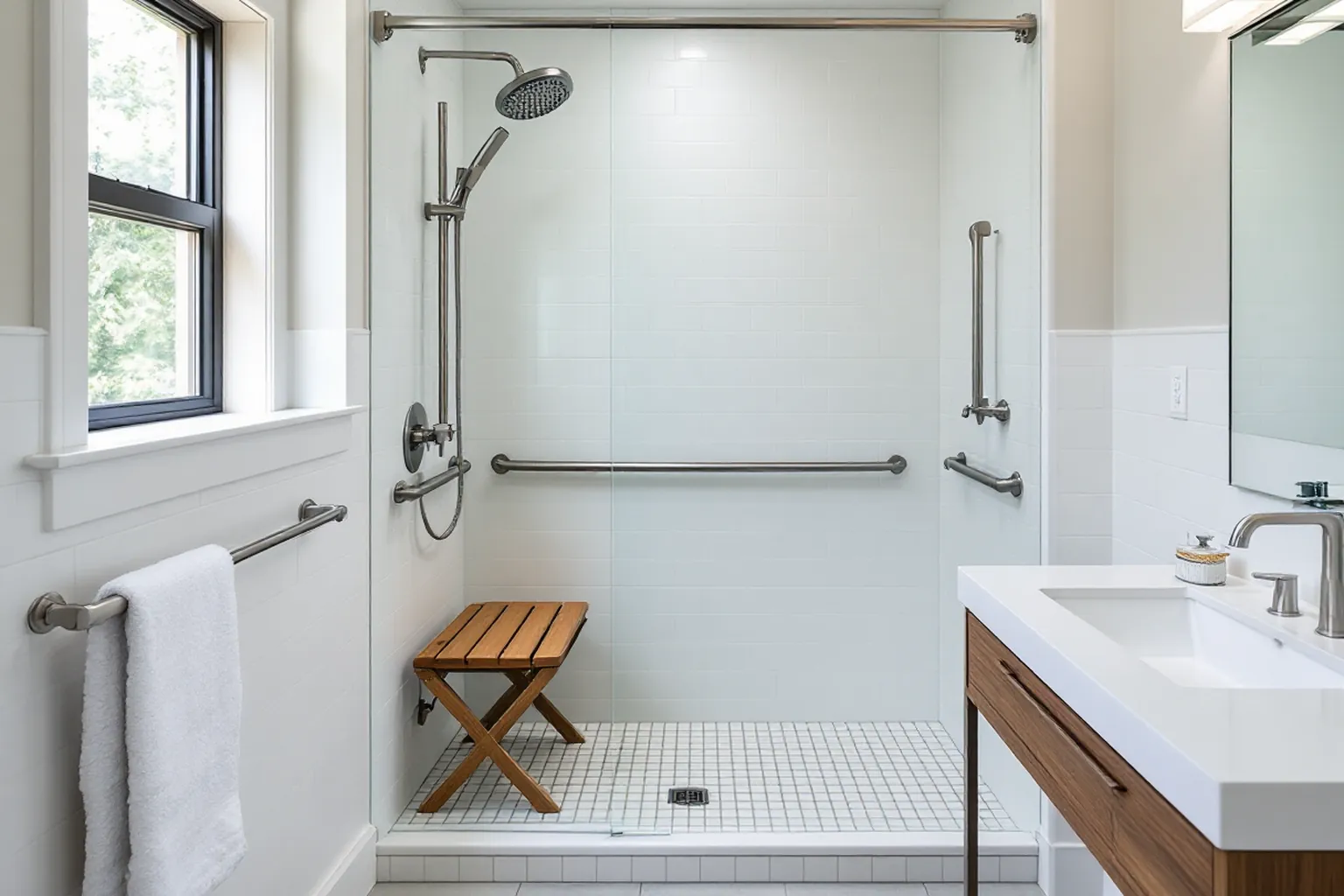
The cost to install grab bars in a shower is about $158 to $398 per bar for basic work, per Homewyse‘s May 2026 national estimate, and a three-bar shower setup runs roughly $300 to $900 on 3 Birds Accessibility‘s 2026 package pricing. The price is mostly about what sits behind the tile: a bar has to survive a 250-pound pull under the 2010 ADA Standards (section 609.8), and by our calculation from Moen‘s anchor test report, the best hollow-wall anchor in half-inch drywall clears that by only about 1.5 times, while a bar screwed into a stud or blocking clears it by 2 or more.
- Low
- $158 per bar installed
- Midpoint (our calculation)
- $278 per bar installed
- High
- $398 per bar installed
Most of a grab bar bill is the minimum service call, not the bar
Homewyse’s one-bar estimate assumes “favorable site conditions” and includes delivery, setup and cleanup, and it carries a 2-hour minimum labor charge; it excludes permits and any repair of framing or finishes, and adds 13% to 22% if a general contractor manages the job (Homewyse). That minimum is why the first bar costs the most and the second and third are cheaper per bar.
Hourly pricing shows the same thing. A Michigan handyman company quotes $50 to $150 per hour for labor and $100 to $300 of labor for one or two bars on drywall, bars not included (East Lansing Handyman). For comparison, the median employee carpenter earned $29.12 an hour in May 2025 (BLS OEWS); the gap between that wage and a billed rate is insurance, travel, tools and the idle time a small job cannot absorb, which our contractor hourly rate report breaks down by trade.
3 Birds Accessibility, a Pittsburgh installer, prices shower and tub bars at $200 to $450 each and fold-down bars at $300 to $700 installed, and says blocking added during work adds $50 to $150 per bar (3 Birds Accessibility). Tile, porcelain and stone cost more than drywall or fiberglass on its list, but it gives no dollar upcharge, and none of the pages we opened did.
Five common shower jobs, priced
Each row names whose figure it is. Where we multiplied or added, the method is in the row.
| Job | Price | How it is built | Source |
|---|---|---|---|
| One straight bar into studs | $158 to $398 | One-bar estimate with 2-hour minimum | Homewyse |
| Two or three bars, one visit | $300 to $900 | Installer package price | 3 Birds |
| Three bars priced as separate visits | $474 to $1,194 | Our calculation: 3 x $158 to $398, a ceiling, not a quote | Homewyse |
| Blocking for three bars while walls are open | +$150 to $450 | Our calculation: 3 x $50 to $150 | 3 Birds |
| Fold-down bar by a shower seat | $300 to $700 | Installed price per bar | 3 Birds |
Sources: Homewyse (May 2026); 3 Birds Accessibility (2026). Multiplications are our calculation.
How much each mounting method holds against the 250-pound rule
This is the part no price page shows. ADA 609.8 says allowable stresses must not be exceeded “when a vertical or horizontal force of 250 pounds (1112 N) is applied at any point on the grab bar, fastener, mounting device, or supporting structure” (ADA.gov). We set each maker’s published rating or test result against that number. Margin = rated or tested load divided by 250 (our calculation).
| Mounting | Wall | Rated or tested load | Margin over 250 lb | Source |
|---|---|---|---|---|
| Bar flange, 3 screws into a wood stud | Any finish over studs | 500 lb pull capacity (maker claim) | 2.0x | Moen INS12302 |
| SecureMount anchor, no stud | 1/2 in bare drywall | Over 300 lb every test; 366 lb average | 1.46x average | Moen test report |
| SecureMount anchor, no stud | 5/8 in bare drywall | Over 300 lb every test; 617 lb average | 2.47x average | Moen test report |
| SecureMount anchor, no stud | 1/8 in tub surround | Passed; test stand maxed at 450 lb | At least 1.8x | Moen test report |
| WingIts RESGBW35 anchor | Drywall with tile | Rated up to 600 lb | 2.4x | WingIts data sheet |
| Suction bar (Moen LR2308W) | Smooth tile or surround | Balance assist only, no weight rating | None | Moen catalog |
Sources: 2010 ADA Standards, 609.8; Moen INS12302 (11/21); Moen SecureMount Anchors Testing Report; WingIts RESGBW35 Technical Data Sheet (2014); Moen Home Care Bath Safety Products catalog. Margins are our calculation.
250 pounds covers a 312-pound person's normal grab, not every fall
Moen’s testing of 20 adults lunging for a bar from their backs found that 95% of people cannot apply more than 80% of their body weight, and that grip speed never lets a load exceed 120% of body weight (Moen). Run the ADA number through those two ratios (our calculation):
- 250 lb / 0.80 = about 312 lb: the heaviest user whose typical hard grab stays under the ADA test load.
- 250 lb / 1.20 = about 208 lb: the heaviest user whose worst-case lunge stays under it.
- 500 lb / 1.20 = about 417 lb: the worst-case user for a bar screwed into studs at Moen’s rated pull. Moen’s instructions limit its bars to people weighing less than 500 pounds (Moen INS12302).
The practical reading: an anchor that only just passes 250 pounds is fine for balance, and thin for a heavy user who will put full weight on the bar getting up off a shower bench. For that user, pay for blocking or a stud location. The 1/2 inch drywall average of 366 pounds is an average across orientations; Moen notes the drywall, not the anchor, failed in every test (our margin column uses that average).
The ADA numbers worth copying at home, quoted from section 609
The 2010 Standards do not govern your house. Federal rules on the same ADA.gov page say that when a business operates in a private residence, “the portion of the residence used exclusively as a residence is not covered” (ADA.gov, 28 CFR 36.401(b)). Still, the numbers are the best-tested placement guide available, and Moen’s instructions tell installers to follow the ADA guidelines for placement (Moen INS12302):
- Diameter: round bars 1 1/4 inch minimum, 2 inch maximum (609.2.1).
- Wall gap: exactly 1 1/2 inch between bar and wall (609.3), so a forearm cannot slip behind it and get trapped.
- Clearance above: 12 inches to anything above the bar, except shower controls and fittings, which may sit 1 1/2 inch away (609.3).
- Height: 33 to 36 inches above the finish floor, measured to the top of the gripping surface (609.4).
- Fittings: the bar must not rotate in its fittings (609.6), and adjacent surfaces must be free of sharp or abrasive edges (609.5).
For showers, section 608.3.1 puts bars “across the control wall and back wall to a point 18 inches (455 mm) from the control wall” in a transfer-type stall. In a roll-in shower with a seat, bars go on the back wall and the wall opposite the seat, never above the seat, within 6 inches of adjacent walls (608.3.2) (ADA.gov 2010 Standards). If you are adding a built-in seat, our sibling guide on how big a shower bench should be covers the seat side; plan the bar wall at the same time.
Even ADA housing only requires blocking, which is the cheap move during a remodel
Section 608.3 has an exception that matters for homeowners: “In residential dwelling units, grab bars shall not be required to be installed in showers” provided reinforcement has been installed so that compliant bars can be added later (ADA.gov). Covered accessible dwelling units can get wood in the wall instead of bars. That is the right model for a house too.
If your walls are open for a bathroom remodel or a tub to shower conversion, blocking costs $50 to $150 per bar location on 3 Birds’ list (3 Birds Accessibility) and turns every later bar into a stud-mount job with a 2.0x margin instead of an anchor job. Ask for horizontal blocking across the whole back and control walls from about 30 to 40 inches above the floor (our suggestion: the ADA 33 to 36 inch band plus 3 to 4 inches each side for flange screws), so the bar height and a vertical entry bar both land on wood; photograph it with a tape measure in frame before the backer board goes on.
Retrofitting onto finished tile is where the bill climbs: the installer has to find studs through tile or drill large holes for an anchor. WingIts’ tile anchor kit uses a carbide bit “rated at 200 holes in ceramic wall tile” and is listed for 1/2 or 5/8 inch drywall with tile, marble or stone (WingIts); Moen’s instructions require both ends of a bar over wood studs unless SecureMount anchors are used (Moen). Neither maker’s documents we opened give a rating for tile set on a mortar bed over masonry, so a stone or mud-set shower needs a quote that names the fastener.
A handyman usually does it, and Medicare will not pay
Who to hire. A grab bar is carpentry and fastening, not plumbing: no supply or drain line is touched. A handyman or carpenter is the usual hire. A plumber makes sense only when the bar is part of a valve move or an integrated grab bar and shelf at the fixture wall. Check your state’s handyman dollar limits in our contractor license by state table before hiring for a larger accessibility job.
Medicare. CMS’s durable medical equipment reference list says “Grab Bars Deny: self-help device; not primarily medical in nature” (CMS NCD 280.1), so Original Medicare does not cover them. Some Medicare Advantage plans offer bathroom safety allowances; ask your plan for the benefit in writing. Our walk-in tub cost guide covers the VA HISA grant, which can fund bathroom access changes for eligible veterans.
Taxes. IRS Publication 502 lists “Adding handrails or grab bars anywhere (whether or not in bathrooms)” among home changes that usually do not raise home value, so the full cost can count as a medical expense, deductible only above 7.5% of adjusted gross income and only if you itemize (IRS Publication 502 (2025)). This is general information, not tax, medical or engineering advice.
For an older user, pick a textured 1 1/2 inch bar in a 24 inch or longer length
The ADA range is 1 1/4 to 2 inches (609.2.1, ADA.gov). Moen sells its peened (textured) stainless bars in both 1 1/4 and 1 1/2 inch diameters (Moen catalog); a textured finish grips better with wet, soapy hands than polished chrome. Length matters for the install as much as for the hand: Moen’s instructions say stud-to-stud mounting at studs “usually 16 in. apart” and its diagonal mount works only on bars 24 inches or longer (Moen INS12302). A 12 or 16 inch bar often cannot reach two studs and forces an anchor.
Suction bars are not grab bars. Moen’s own catalog says its suction model “is for balance assist only” and is not meant to take body weight (Moen). With 632,373 emergency-room injuries in home bathrooms in 2025 by our tabulation of CPSC NEISS data (see our bathroom accident statistics), a suction cup is the wrong place to save. Our aging in place statistics report shows how few owner households make accessibility improvements at all.
Frequently Asked Questions
How much does a handyman charge to install grab bars?
One Michigan handyman company quotes $50 to $150 per hour and $100 to $300 of labor for one or two bars on drywall, bars extra (East Lansing Handyman). Homewyse puts a full one-bar job at $158 to $398 including materials and a 2-hour minimum (Homewyse).
Do plumbers install grab bars in showers?
Some do, but no plumbing is involved, so a handyman or carpenter is the usual and cheaper hire. Use a plumber when the bar is part of moving a shower valve or rebuilding the fixture wall.
Does Medicare pay for grab bars for seniors?
Original Medicare does not. CMS lists grab bars as “Deny: self-help device; not primarily medical in nature” (CMS NCD 280.1). Some Medicare Advantage plans include bathroom safety benefits, and the cost can count as a medical expense under IRS Publication 502.
What type of grab bar is best for seniors?
A textured (peened) stainless bar 1 1/4 to 1 1/2 inch in diameter, within the ADA’s 1 1/4 to 2 inch range (ADA 609.2.1), long enough (24 inches or more) to hit two studs, mounted 33 to 36 inches high with a 1 1/2 inch wall gap.
Can grab bars be installed without studs?
Yes, with rated hollow-wall anchors. Moen’s SecureMount anchor averaged 366 lb in 1/2 inch drywall and 617 lb in 5/8 inch drywall in its test report (Moen), against the ADA’s 250 lb test load. Studs or blocking give more margin.
Sources
- U.S. Department of Justice (ADA.gov), 2010 ADA Standards for Accessible Design, sections 608.3, 609 and 28 CFR 36.401 (2010)
- Homewyse, Cost to Install Grab Bars: 2026 Cost Calculator (2026)
- 3 Birds Accessibility, Grab Bar Installation Cost in 2026: What Homeowners Should Expect (2026)
- East Lansing Handyman, How much does labor cost to install a grab bar?
- Moen, SecureMount Anchors Testing Report (BA0721)
- Moen, Installation Instructions for Grab Bars, INS12302 (2021)
- Moen, Moen Home Care Bath Safety Products catalog (BA0706)
- WingIts, RESGBW35 Technical Data Sheet (2014)
- Centers for Medicare and Medicaid Services, NCD 280.1 Durable Medical Equipment Reference List
- Internal Revenue Service, Publication 502, Medical and Dental Expenses (2025) (2025)
- U.S. Bureau of Labor Statistics, Occupational Employment and Wage Statistics, May 2025 national estimates (2026)
- U.S. Consumer Product Safety Commission, NEISS 2025 public data file (2026)