Bathroom costs
Walk In Tub Cost: Installed Prices, Hot Water Needs and Who Pays
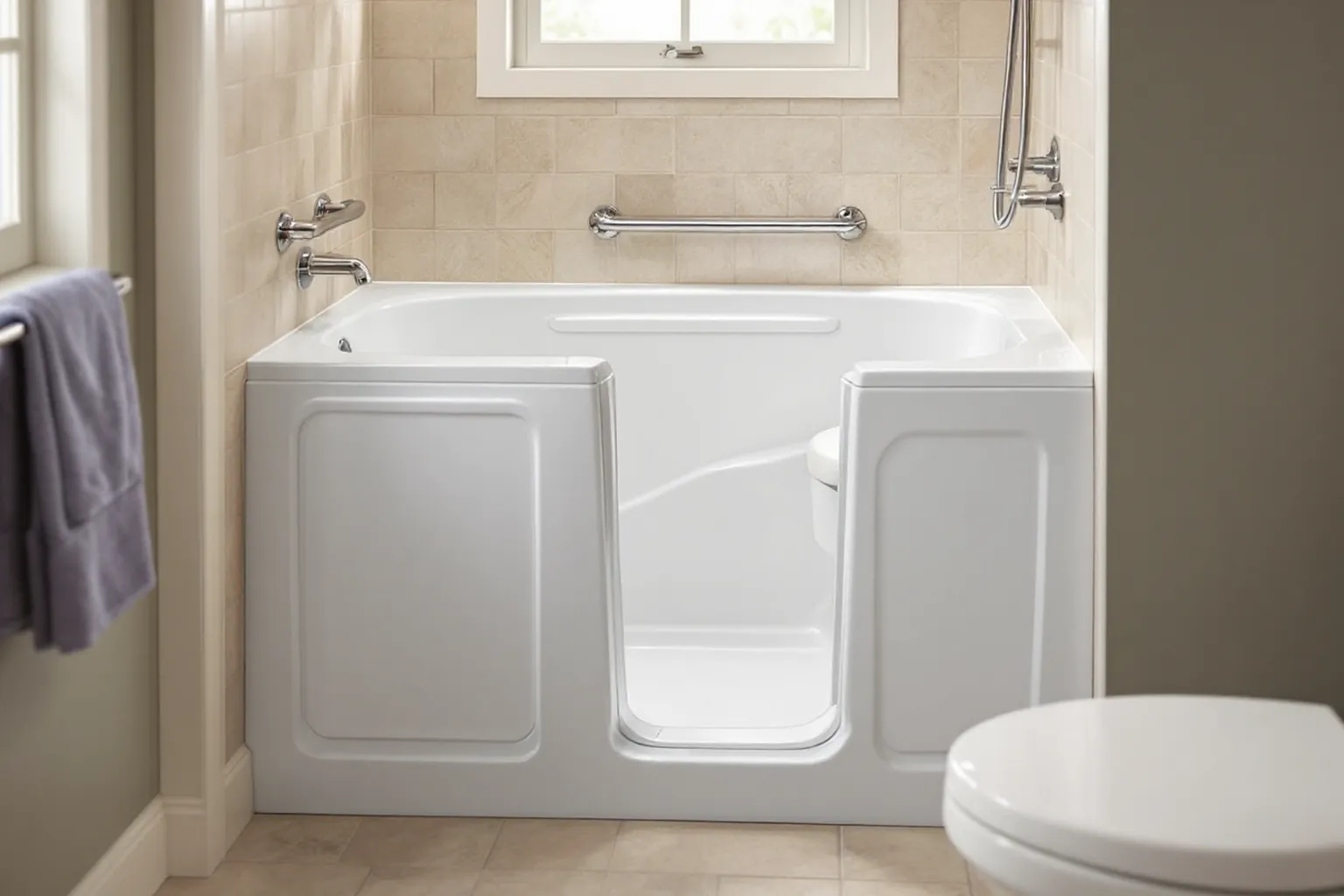
Walk in tub cost runs about $3,000 to $17,000 installed per NCOA, with a national average near $6,000 per Fixr, while in-home dealer brands quote far higher: Kohler puts its own installed average at $20,000 to $29,000 (Reveal by KOHLER). The bill most guides skip is hot water: in our calculation from 12 maker spec sheets, the median walk-in tub needs 52 gallons of 120°F water per bath, more than a 50-gallon tank holds.
- Low
- $3,000 installed
- National average
- $6,000 installed
- High
- $17,000 installed
The $6,000 guide price and the $20,000 dealer quote are both real
Cost guides price the tub and the labor separately and add them up. This Old House puts a standard 60 by 32 inch walk-in tub at about $4,600 installed, with basic installation (removal, placement, plumbing hookup, sealing) at $1,500 to $3,500. Fixr gives $3,500 to $10,000 with labor at $1,000 to $3,500. Those numbers describe a tub bought from a retailer or plumbing supplier and set by a local plumber.
The brands that sell through in-home appointments quote one bundled price that includes demolition, wall panels, the tub, and their own crew. Safe Step lists $10,000 to $26,000 installed, and Reveal by KOHLER lists $20,000 to $29,000. Both advertise discounts and 0% financing, and Kohler says its quote is honored for 90 days. If a first quote arrives at kitchen-remodel money, ask for a line-item breakdown and get a second bid from a plumber who installs retail tubs. Our guide on choosing a remodeling contractor covers how to compare bids that bundle different things.
The tub itself varies by type. This Old House lists basic soaking tubs at $2,000 to $4,000, hydrotherapy (whirlpool) at $4,750 to $7,500, wheelchair-accessible at $5,000 to $12,000 and two-seaters at $10,700 to $13,700, before installation.
What goes into the installed price, line by line
Each line is a named publisher’s range. Not every job needs every line; a tub that drops into the old 60 inch alcove with an existing outlet nearby skips the electrical and most of the plumbing.
| Line item | Range | Source |
|---|---|---|
| Tub, basic soaker | $2,000 to $4,000 | This Old House |
| Tub, hydrotherapy or air jets | $4,750 to $9,000 | This Old House |
| Basic installation labor | $1,000 to $3,500 | Fixr |
| Install with floor, drain or electrical changes | $5,000 or more | This Old House |
| Old tub removal (if billed) | $250 to $700 | Reveal by KOHLER |
| Wall panels, grab bars, shower option | $1,000 to $6,000+ | Reveal by KOHLER |
| Quick-fill faucet / rapid-release drain | $150 to $500 / $200 to $400 | Fixr |
| Permit for plumbing or electrical work | $150 to $1,000 | Fixr |
| Water heater upgrade to 50+ gallons | up to $5,600 | Reveal by KOHLER |
Sources: This Old House (updated June 2026), Fixr (updated Jan 2026), Reveal by KOHLER pricing page (2026).
Seven of 12 walk-in tubs need more hot water than a 50-gallon tank holds
We read 12 current spec sheets from four makers and took the top of each stated water range, since a bath has to be planned for the bigger fill. Hot water needed is our calculation: a 104°F bath mixed from 58°F inlet water (the supply temperature in the federal test procedure, 10 CFR 430 Appendix E) and a tank set to 120°F (the setting DOE recommends) is (104 minus 58) divided by (120 minus 58) = 0.742 hot water. The last column compares that to a 50-gallon tank’s full nameplate volume, the best case before the outlet cools.
| Model (spec sheet) | Water stated (gal) | Hot water needed (gal) | Share of 50-gal tank | Step-in (in) |
|---|---|---|---|---|
| Ella’s Bubbles Front Entry 32x40 | 25 to 55 (occupied) | 41 | 82% | n/s |
| Ella’s Bubbles Mobile 26x45 | 35 to 55 (occupied) | 41 | 82% | n/s |
| Meditub 3060 step-in | 40 to 50 (with bather) | 37 | 74% | 7.5 |
| American Standard 3052.509 | 60 (operating) | 45 | 89% | n/s |
| Aquarite HW305930 step-in | 60 to 65 (empty) | 48 | 96% | n/s |
| Meditub 2653 | 60 to 70 (with bather) | 52 | 104% | 7 |
| Meditub 3060 | 60 to 70 (with bather) | 52 | 104% | 7.25 |
| Ella’s Bubbles OLA3655 wheelchair | 55 to 75 (occupied) | 56 | 111% | 6 |
| Meditub 2853 | 70 to 80 (with bather) | 59 | 119% | 6 |
| Ella’s Bubbles Ultimate 30x60 | 55 to 85 (occupied) | 63 | 126% | n/s |
| Ella’s Bubbles Tub4Two 32x60 | 65 to 85 (occupied) | 63 | 126% | n/s |
| Meditub 3060 wheelchair access | 80 to 90 (with bather) | 67 | 134% | 13.5 |
Sources: maker spec sheets linked in each row (Ella’s Bubbles, Meditub/SW Corp, American Standard, Aquarite), opened 2026-11-21. Hot water = top of stated range x 0.742, our calculation from the eCFR test inlet temperature and the DOE 120°F setting. n/s = not stated on the sheet.
Your water heater decides whether the bath ends warm
Across the 12 sheets the median tub needs 52 gallons of 120°F water per fill (our calculation, see the table above). 11 of the 12 need more than a 40-gallon tank holds and 7 need more than a 50-gallon tank holds. That matters because most homes have the smaller tank: in the federal 2020 household energy survey, 58.5% of homes with their own water heater reported a tank under 50 gallons (10.8% at 30 gallons or less, 47.7% at 31 to 49), per our tabulation of EIA RECS 2020 microdata in our water heater sizing report.
A first-hour rating helps less than it looks, because it counts an hour of reheating and a walk-in tub fills in minutes. Ella’s spec sheets rate their fast-fill faucets at up to 16 gallons per minute at 60 psi (Ella Ultimate spec sheet), so an 85-gallon fill takes about 5.3 minutes (our calculation: 85 / 16). Kohler’s own pricing page recommends a new 50+ gallon tank for its walk-in bath and prices the upgrade at up to $5,600 (Reveal by KOHLER).
Tankless heaters run into a flow limit instead of a volume limit. At 16 gpm the faucet wants 11.9 gpm of hot water (16 x 0.742, our calculation), but the median certified gas tankless unit is rated at 5.4 gpm (ENERGY STAR certified water heater data). Hot-limited, an 85-gallon tub fills at about 7.3 gpm and takes 11.7 minutes (our calculation: 5.4 / 0.742, then 85 / 7.3). Our tankless vs tank comparison covers the running-cost side.
Do not count on the tub’s built-in heater to close the gap. The Meditub and American Standard sheets both say the inline heater maintains water temperature during jet use and “will not heat cold water to desired bathing temperature” (American Standard 3052.509 sell sheet). For how walk-in fills compare with ordinary tubs, our registry of how many gallons a bathtub holds puts the median standard alcove tub at 58.2 gallons to overflow.
You sit in the tub while it fills and while it drains
The door has to be shut before water goes in and stay shut until the water is out, so the bather sits through both. That is the downside owners mention most, and the spec sheets let you put minutes on it. Fill time at a 16 gpm faucet runs from about 3.1 minutes for a 50-gallon step-in to 5.6 minutes for a 90-gallon wheelchair model (our calculation: stated gallons / 16 gpm, faucet rating from Ella spec sheets). Ordinary household plumbing often delivers less than the 60 psi those ratings assume, which stretches the wait.
Draining is quicker on tubs with two drains. Ella lists about 80 seconds for its 95-gallon Ultimate and 120 seconds for the 100-gallon Tub4Two, both unoccupied and “at ideal plumbing conditions” (Ella Tub4Two spec sheet). Many models offer a heated seat or backrest for this reason; Ella lists one as an option drawing 4 amps (Ella Ultimate spec sheet).
- Step-in height on the sheets that state it runs from 6 to 7.5 inches for standard walk-in models and 13.5 inches on the Meditub wheelchair-access model (Meditub 3060 WCA sheet); Kohler advertises a 3 inch threshold (Reveal by KOHLER).
- Seats sit 16.75 to 17 inches high on the Meditub 2653 and 3060 (Meditub 3060 spec sheet), close to chair height, so getting up is easier than from a tub floor.
- Jetted models need a dedicated GFCI circuit: 15 amps for air or whirlpool, 20 amps with an inline heater, per the Meditub 2653 sheet. See our GFCI requirements guide for where code requires protection.
Medicare says no, the VA says maybe, and the IRS counts it as medical
Original Medicare. CMS’s durable medical equipment list denies bathtub lifts and bathtub seats as convenience items “not primarily medical in nature” (CMS NCD 280.1), and a walk-in tub is a permanent fixture, not rentable equipment, so it fails the DME test. Some Medicare Advantage plans and state Medicaid home and community-based waivers can help with home modifications, depending on the plan and state (NCOA).
VA HISA grant. The Home Improvements and Structural Alterations benefit pays a lifetime maximum of $6,800 for service-connected conditions (or any condition for veterans rated 50% or more service-connected) and $2,000 for other conditions, for medically justified changes to a primary residence such as bathroom access. The same page excludes “spas, hot tubs, or Jacuzzi-type tubs” (U.S. Department of Veterans Affairs), so a jetted walk-in tub is a hard sell; a plain soaker with a provider’s justification has a better chance.
Taxes. IRS Publication 502 lets you count a medical home improvement in full when it does not raise the home’s value, and lists “installing railings, support bars, or other modifications to bathrooms” among changes that usually do not; only the part of total medical costs above 7.5% of adjusted gross income is deductible, and only if you itemize (IRS Publication 502 (2025)). Our article on whether a bathroom remodel is tax deductible walks through the math. This is general information, not tax or legal advice.
When a walk-in shower is the better buy
For someone who mainly needs to get clean safely, a walk-in shower usually costs about the same or less and has no fill wait, no door seal and no hot water problem. Fixr puts a walk-in shower at $5,000 to $11,000 with an $8,000 average, against $3,500 to $10,000 for a walk-in tub from the same publisher. The tub wins when the person wants to soak for joint pain or cannot stand for a shower, and a seated shower with a handheld wand does not work for them.
Price both before deciding: our walk-in shower cost guide and tub to shower conversion cost break down those jobs, and the aging in place statistics report shows how many older households still face steps and tub walls at home.
Frequently Asked Questions
What is the actual cost of a walk-in tub?
Most installed walk-in tubs land between $3,000 and $17,000 (NCOA), with a $6,000 national average from Fixr. Brands that sell through in-home consultations quote more: Safe Step lists $10,000 to $26,000 and Kohler $20,000 to $29,000. Add up to $5,600 if you need a bigger water heater (Reveal by KOHLER).
Does Medicare pay for a walk-in tub?
Original Medicare does not. CMS denies bathtub lifts and bath seats as convenience items (CMS NCD 280.1), and a built-in tub is not durable medical equipment. Some Medicare Advantage plans and state Medicaid waivers may help (NCOA).
What are the downsides of a walk-in tub?
You sit inside while it fills and drains, which takes several minutes each way on the spec sheets above; the median model needs about 52 gallons of hot water per bath (our calculation), more than many tanks hold; the door seal is one more part to maintain; and jetted models need a dedicated GFCI circuit.
What is cheaper, a walk-in tub or a walk-in shower?
They overlap. Fixr puts walk-in tubs at $3,500 to $10,000 and walk-in showers at $5,000 to $11,000, but a shower needs no water heater upgrade and no fill wait, which often makes it the cheaper choice once the whole job is priced.
Will the VA pay for a walk-in tub?
Possibly, through the HISA grant: up to $6,800 lifetime for service-connected conditions or $2,000 otherwise, with medical justification. The VA excludes spas, hot tubs and Jacuzzi-type tubs (VA), so jetted models are unlikely to qualify.
Sources
- NCOA, Understanding the Cost of Walk In Tubs (2026)
- Fixr, How Much Does It Cost to Install a Walk-in Tub? (2026 Data) (2026)
- This Old House, How Much Does Walk-In Tub Installation Cost? (2026)
- Reveal by KOHLER, Walk-In Bath Pricing, Installation Costs (2026)
- Reveal by KOHLER, Low Step-In Tub Features
- Safe Step, How Much Does a Walk-In Tub Cost in 2026? (2026)
- Fixr, Walk-in Shower Cost (2025)
- Ella's Bubbles, Mobile Acrylic Outward Swing Door Walk-In Bathtub Specifications (2023)
- Ella's Bubbles, Front Entry Acrylic Outward Swing Door Walk-In Bathtub Specifications (2023)
- Ella's Bubbles, Ultimate Acrylic Inward Swing Door Walk-In Bathtub Specifications
- Ella's Bubbles, Tub4Two Acrylic Outward Swing Door Walk-In Bathtub Specifications
- Ella's Bubbles, OLA3655A Wheelchair Accessible Walk In Bathtub specifications (Home Depot copy)
- Meditub (SW Corp), 2653 Walk-In Bathtub specifications (2019)
- Meditub (SW Corp), 3060 Walk-In Bathtub specifications (2019)
- Meditub (SW Corp), 2853 Walk-In Bathtub specifications (Lowe's copy)
- Meditub (SW Corp), 3060 Step-In Bathtub specifications (AmeriGlide copy)
- Meditub (SW Corp), 3060 Wheelchair Access Bathtub specifications (AmeriGlide copy)
- American Standard, 3052.509 Value Series 30 x 52 Walk-in Bath sell sheet (2023)
- Aquarite, HW305930 step-in tub specifications (Home Depot copy)
- eCFR, Appendix E to Subpart B of 10 CFR Part 430, Uniform Test Method for Water Heaters (2026)
- U.S. Department of Energy, Do-It-Yourself Savings Project: Lower Water Heating Temperature (Internet Archive capture)
- U.S. EPA ENERGY STAR, ENERGY STAR Certified Water Heaters dataset (2026)
- U.S. Energy Information Administration, 2020 Residential Energy Consumption Survey public use microdata (2023)
- U.S. Department of Veterans Affairs, Home Improvements and Structural Alterations (HISA)
- Centers for Medicare and Medicaid Services, NCD 280.1, Durable Medical Equipment Reference List (2025)
- IRS, Publication 502 (2025), Medical and Dental Expenses (2025)