Kitchen costs
Cost to Move Kitchen Sink to Island: What the Drain, Vent and Floor Add
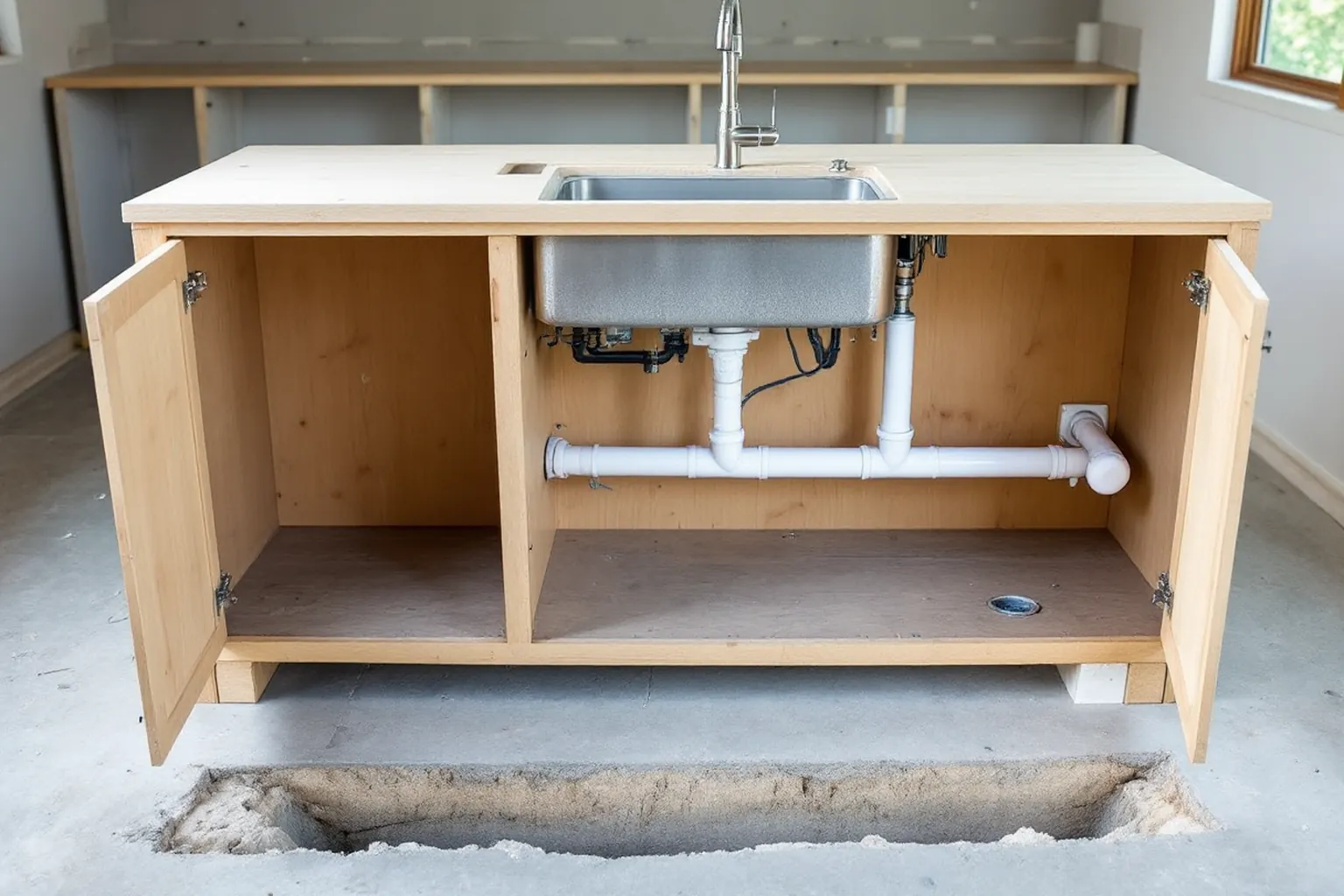
The cost to move kitchen sink to island is usually $2,500 to $6,000 or more for the plumbing alone, the range Vatten Plumbing gives for new island sink plumbing, before the island cabinet, top and electrical. Where you land in that range comes down to one measurable thing: how far the new drain has to run to reach a pipe that can take it, because every foot of run costs a quarter inch of fall under the International Code Council slope rule, and that fall has to fit inside your joists or under your slab.
- Low
- $2,500 plumbing only
- Midpoint
- $4,250 plumbing only
- High
- $6,000 plumbing only
What the island sink price buys, line by line
An island sink needs four things the old wall sink already had: a drain with steady fall, a vent so the trap does not siphon dry, hot and cold supply lines, and usually a dishwasher and disposal hookup. Published ranges price these pieces separately, which is why quotes for the same move can differ by thousands.
- Running the new lines: Fixr puts running plumbing lines to an island at $200 to $1,000, and Homewyse puts a basic relocated piping run at $935 to $1,138 (May 2026), excluding wall and floor repair.
- Setting the sink and faucet: Fixr lists $400 to $1,000 to install the sink itself.
- Moving the dishwasher with it: Vatten Plumbing lists $300 to $1,200 for dishwasher relocation.
- Opening and closing floors or walls: Vatten Plumbing lists $500 to $2,000 for wall or floor repairs after access work. On a slab, see the concrete figures below.
- Contingency: Vatten Plumbing suggests holding 10 to 20 percent of the plumbing budget for surprises, and Homewyse adds 13 to 22 percent when a general contractor supervises.
None of that includes the island box, countertop or outlets. Those are priced in our guide to the cost to add a kitchen island, and Fixr puts a finished island with a sink and dishwasher at $6,500 to $8,000.
Every foot of drain costs a quarter inch of height
Drain pipe 2-1/2 inches and smaller must fall at least 1/4 inch per foot, and 3 to 6 inch pipe at least 1/8 inch per foot, per Table 5-2 in the ICC Plumbing Code Essentials (the same values the residential code uses in section P3005). A kitchen sink branch is small pipe, so the quarter inch applies until it joins a 3 inch or larger line.
That turns the move into simple arithmetic: drop in inches equals run in feet times 0.25. The table below is our calculation for common island distances. The drop is what has to fit between the island and the pipe you tie into, whether that space is a joist bay, a basement ceiling or a trench in concrete.
Drain fall by distance from the island
Run is the horizontal distance from the island trap to the tie-in point. The joist column assumes 2 inch PVC crossing 2x10 joists at right angles (method in the next table). The last column applies to a 1-1/2 inch trap; see the venting section.
| Run | Fall at 1/4 in per ft | Fall at 1/8 in per ft (3 in pipe) | Through 2x10 joists? | 1-1/2 in trap arm |
|---|---|---|---|---|
| 4 ft | 1 in | 0.5 in | Yes | Can reach a wall vent |
| 6 ft | 1.5 in | 0.75 in | Yes | Can reach a wall vent |
| 8 ft | 2 in | 1 in | Yes | Needs island vent or AAV |
| 10 ft | 2.5 in | 1.25 in | Yes | Needs island vent or AAV |
| 12 ft | 3 in | 1.5 in | No, over 11.5 ft | Needs island vent or AAV |
| 15 ft | 3.75 in | 1.875 in | No, over 11.5 ft | Needs island vent or AAV |
| 20 ft | 5 in | 2.5 in | No, over 11.5 ft | Needs island vent or AAV |
| 25 ft | 6.25 in | 3.125 in | No, over 11.5 ft | Needs island vent or AAV |
Our calculation. Slopes: ICC, Plumbing Code Essentials Table 5-2. Trap distance: ICC, Methods of Venting (2021 IPC), Table 909.1. Joist limit: see table below.
Over a basement or crawlspace, your joists set the distance limit
If the drain runs parallel to the floor joists, it simply hangs in the joist bay and the fall is easy. If it has to cross them, each joist gets a hole, and the code limits those holes: no closer than 2 inches to the top or bottom edge and no wider than one third of the joist depth, per IRC R502.8.1 as summarized by the City of Minneapolis building guide. Because the pipe drops as it goes, each hole sits a little lower than the last, and you run out of drillable wood.
Our calculation: usable bore zone = actual joist depth minus 4 inches; travel = bore zone minus pipe outside diameter (1.900 inches for 1-1/2 inch and 2.375 inches for 2 inch Schedule 40 PVC, per the Charlotte Pipe submittal sheet); maximum crossing run = travel divided by 0.25. Real holes are a little larger than the pipe, so treat these as best cases.
Engineered I-joists, trusses and LVL are a different case: the same Minneapolis guide quotes IRC R502.8.2, which bans holes in them unless the effects were considered in the design, so the maker’s hole chart or an engineer decides. If your joists are I-joists, plan on running the drain below them in a soffit or along the bays.
How far a drain can cross sawn joists
| Joist (actual depth) | Largest hole (1/3 depth) | Bore zone | Max run, 2 in PVC | Max run, 1-1/2 in PVC |
|---|---|---|---|---|
| 2x8 (7.25 in) | 2.42 in | 3.25 in | 3.5 ft | 5.4 ft |
| 2x10 (9.25 in) | 3.08 in | 5.25 in | 11.5 ft | 13.4 ft |
| 2x12 (11.25 in) | 3.75 in | 7.25 in | 19.5 ft | 21.4 ft |
Our calculation from IRC R502.8.1 limits (City of Minneapolis, Cutting, Notching and Boring Wood Frame Members) and pipe diameters from Charlotte Pipe. Fall at 1/4 in per ft (ICC).
The vent, not the drain, is what trips up island sinks
A wall sink vents up through the wall behind it. An island has no wall, and the trap can only sit so far from a vent: 6 feet for a 1-1/2 inch trap and 8 feet for a 2 inch trap at 1/4 inch per foot, per Table 909.1 in the ICC venting guide (the residential code table, P3105.1, uses the same distances). A sink more than 6 feet from the nearest wall vent needs one of two fixes.
- Island fixture vent (loop vent). The vent rises inside the cabinet above the drain outlet, turns down, and runs below the floor to a vent that climbs a nearby wall. The vent piping below the sink rim is installed like drain pipe and needs cleanouts so it can be rodded, per the ICC description of 2021 IPC section 912 (IRC P3112 is the residential version). Permit Sonoma, which enforces the UPC-based California code, calls this a last resort and requires 1/4 inch per foot fall on the foot vent and an accessible cleanout.
- Air admittance valve (AAV). A one-way valve in the sink cabinet lets air in without a pipe to the roof. The ICC guide says it must sit at least 4 inches above the drain it vents and stay accessible, and a sink cabinet counts. The building still needs at least one open vent to the outdoors (IRC P3114 covers AAVs). Some local codes restrict AAVs, so ask before you plan around one.
Which family of code you are under matters here. Our plumbing code by state map counts 26 states on an IPC-based code and 11 on a UPC-based one, from the ICC adoption chart; the venting rules above differ between the two families and by local amendment.
Slab, crawlspace or basement: what each adds
| Under the kitchen | How the drain gets there | Plumbing (named range) | Access and repair | Watch for |
|---|---|---|---|---|
| Unfinished basement | Hangs from or bores through joists | $935 to $1,138 per run (Homewyse) | Little or none | Joist hole limits |
| Crawlspace | Same, working on your back | $200 to $1,000 to run lines (Fixr) | Little or none | I-joists, tight clearance |
| Finished basement | Through the finished ceiling | $935 to $1,138 per run (Homewyse) | $500 to $2,000 (Vatten) | Ducts and wiring in the bays |
| Slab on grade | Trench cut in the concrete | $500 to $4,000 under-slab work (This Old House) | $2,000 to $7,500 concrete restoration (This Old House) | Post-tension cables |
Homewyse (May 2026); Fixr, kitchen island installation (2025); Vatten Plumbing (2026); This Old House, slab leak repair cost, HomeAdvisor data (updated April 2026). Ranges are from different publishers and do not add up to one quote.
On a slab, the trench is the job
In a slab house the new drain goes under the concrete. A crew saw-cuts a strip from the island to the nearest drain line, digs the trench, lays pipe at the required fall, gets it inspected, backfills and patches the concrete, then the flooring on top is repaired. This Old House, using HomeAdvisor data, prices under-slab plumbing access at $500 to $4,000 and what it labels foundation repair at $2,000 to $7,500, which is why slab moves sit at the top of every published range.
The fall table still applies: a 15 foot trench has to end 3.75 inches deeper than it starts (our calculation at 1/4 inch per foot). If the existing drain you are tying into is shallow, that depth may not exist, and the run has to go somewhere else.
Before anyone cuts, find out whether the slab is post-tensioned. Concrete Network warns never to cut or drill a post-tensioned slab because a cut tendon is very hard to repair, notes the cables are pulled to 33,000 pounds, and says many such slabs are stamped to warn owners and contractors. If you see the stamp, the job needs an engineer and scanning, not a saw.
Labor is most of the bill, and plumbers are booked
Fixr puts plumber rates at $75 to $150 an hour. Behind that, plumbers had the highest median wage of the eight remodeling trades we track, $30.67 an hour in May 2025 from BLS OEWS data; our contractor hourly rate report shows how that varies by state. The gap between wage and billed rate is overhead, insurance, truck and licensing.
Scheduling can stretch the job. BLS projections show about 42,000 openings a year for plumbers from 2025 to 2035, and our plumber shortage analysis finds apprenticeship completions fill only about one in ten of them. Book the plumber before the cabinets are ordered, because the rough-in has to be inspected before the island goes in. Our kitchen remodel timeline shows where rough-in falls in the sequence.
Price your own island move in five measurements
- Step 1
Measure the run
Tape the distance from the planned sink center to the nearest drain stack or main you can reach. Multiply by 0.25 for the fall in inches (our calculation, from the ICC slope rule above).
- Step 2
Check what is below
Basement, crawlspace or slab, and which way the joists run. Crossing joists at a right angle is where the limits in the joist table bite.
- Step 3
Identify the joist type
Sawn lumber can be bored within limits; I-joists and trusses generally cannot without the maker or an engineer signing off.
- Step 4
Ask how it will be vented
Loop vent or AAV, and whether your local code accepts the AAV. Get it in writing on the quote.
- Step 5
Confirm the permit
Moving a drain is new plumbing work, so expect a permit and a rough-in inspection. See whether a kitchen remodel needs a permit.
Frequently Asked Questions
Is it expensive to move a sink in a kitchen?
It depends on distance and what is under the floor. Vatten Plumbing puts a sink moved several feet at $1,500 to $3,500 and a new island sink at $2,500 to $6,000 or more; slab houses add concrete work that This Old House prices at $2,000 to $7,500 to restore.
Is it a good idea to put a sink in an island?
It works well when the island faces the room and you have enough landing space on both sides, and it lets you face guests while you prep. The trade-off is splash and dirty dishes in the center of the kitchen, plus a vent that is harder to build. If you are still choosing a layout, compare a peninsula vs an island: a peninsula touches a wall, which makes venting simpler.
How much does a plumber charge to move a sink?
How difficult is it to relocate a kitchen sink?
Short moves along the same wall are simple. Moving to an island is a code job: the drain needs 1/4 inch of fall per foot (ICC), the trap must be within 6 feet of a vent for a 1-1/2 inch trap (ICC), and joist or slab limits apply. It usually needs a licensed plumber, a permit and an inspection. Not engineering advice; your local code official has the final word.
Sources
- Vatten Plumbing, Cost to Move Plumbing in a Kitchen: What to Expect (2026)
- Homewyse, Cost to Move Plumbing, 2026 Cost Calculator (May 2026)
- Fixr, How Much Does It Cost to Install Plumbing in a Kitchen Remodel? (2025-01-30)
- Fixr, Kitchen Island Installation Cost (2025-02-07)
- This Old House, Slab Leak Repair Cost (HomeAdvisor data) (2026-04-07)
- International Code Council, Plumbing Code Essentials, Installation (2018 IPC), Table 5-2 Slope of horizontal drain pipe (2018)
- International Code Council, Methods of Venting Plumbing Fixtures and Traps in the 2021 IPC (2020)
- Permit Sonoma, Technical Bulletin P-09: Island Fixture Venting (2020-03-01)
- City of Minneapolis, RES-MS-012: Cutting, Notching and Boring Wood Frame Members (2009-01)
- Charlotte Pipe and Foundry, PVC Schedule 40 DWV Pipe submittal (FO-SUB-PVC-DWV)
- Concrete Network, Post-Tensioning Construction Basics
- U.S. Bureau of Labor Statistics, OEWS May 2025 national estimates (2026-05-15)
- U.S. Bureau of Labor Statistics, Employment Projections 2025 to 2035, occupation tables (2026)
- International Code Council, International Codes: Adoption by State (April 2026) (2026-04)