Kitchen planning
Do You Really Need a Range Hood? The Code, Your Range Manual and Your Lungs
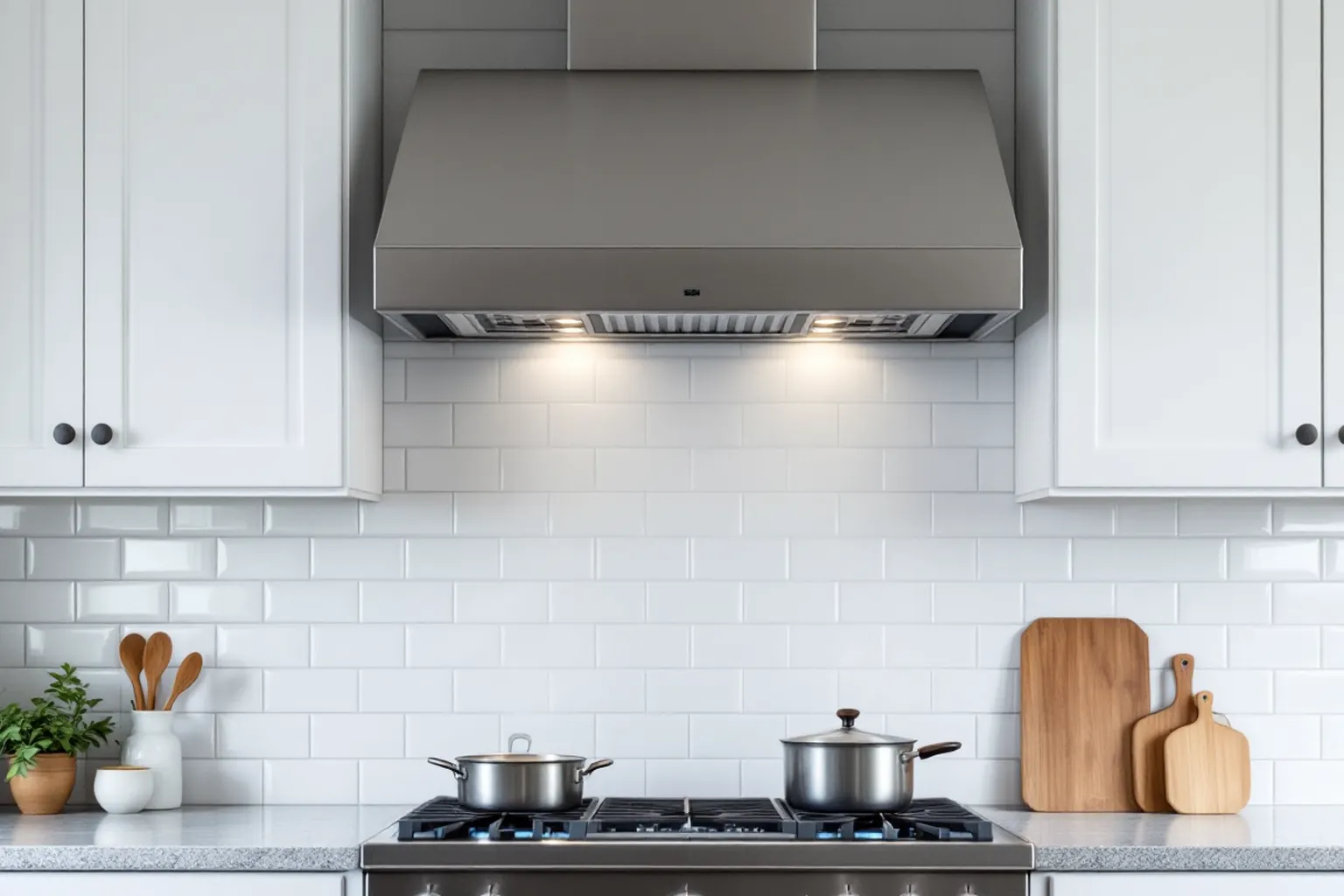
Do you really need a range hood? In most US homes the building code does not make you install one: the International Code Council says its residential code (the IRC most towns adopt) “has not previously required a range hood”, and North Carolina’s State Fire Marshal ruled in 2019 that listed home ranges, gas or electric, need none. Kitchen exhaust becomes mandatory in four situations: the kitchen has no openable window (2021 IRC, where a fan can substitute), you are building new in California or Washington, the range has an open-top gas broiler, or the range’s installation instructions call for a hood, which often happens when cabinets sit less than 30 inches above the burners. Outside those cases it is a health choice, and on a gas range it is a strong one.
The model code regulates hoods you install, not hoods you skip
Most range hood articles say “check your local code” and stop. Here is what the code actually says. The ICC Building Safety Journal summary of the 2021 International Residential Code puts it plainly: the IRC sets installation rules for kitchen exhaust but has not required a range hood. The 2021 edition added one condition: a kitchen without natural ventilation through openable windows and doors must have local mechanical exhaust, so that cooking pollutants are “captured and exhausted at their source.”
North Carolina’s Office of the State Fire Marshal answered the question directly in an official interpretation dated March 18, 2019: “Do listed domestic ranges, gas or electric, require a hood? No.” Its reasoning applies anywhere the International Mechanical and Fuel Gas Codes are adopted. The hood section sets rules that apply if a hood is installed (ducted to the outdoors in sheet metal, with a backdraft damper), and the fuel gas code lists ranges first among appliances “not required to be vented.” A gas range is legally an unvented appliance, the same category as a refrigerator.
That is the model code. Two things override it: a state or city amendment, and the paperwork that came in the box with your range. Both are covered below, and both catch people mid-remodel. If your project already needs a permit (see when a kitchen remodel needs a permit), the inspector will check the hood against the code your town adopted, not against this summary.
Eight kitchens, three codes: where a hood stops being optional
We read the code text for each situation below (method and sections in the source line). Our tally: under the model IRC, an actual hood is mandatory in 2 of these 8 situations, some form of local exhaust in 1 more, and a hood is one of two ways to satisfy the rule in 2 others. In new California and Washington homes, kitchen exhaust is required in every case. Airflow numbers are minimums for code compliance, not a sizing recommendation; the range hood CFM research covers sizing.
| Situation | Model IRC (most states) | California new home | Washington |
|---|---|---|---|
| Electric range, kitchen has an openable window | No hood required | Required in new homes: 110 to 160 CFM | Required: 160 CFM or 65% capture |
| Any range, no openable window | Local exhaust required (hood or fan) | Required in new homes | Required |
| Standard gas range or cooktop | No hood required; range is an unvented appliance | Required in new homes: 180 to 280 CFM | Required: 250 CFM or 80% capture |
| Pro range with open-top gas broiler | Hood required (fuel gas code 623.5) | Hood required | Hood required |
| Instructions call for a hood | Required: the listing governs | Required | Required |
| Cabinet 24 to 30 in above burners | Protect cabinet bottom per the range sheet; hood often specified | Same | Same |
| Hood rated over 400 CFM | Makeup air for the excess | Check local amendment | Check local amendment |
| Ductless (recirculating) hood | Allowed where no hood is required | Check with building department | Only with continuous exhaust in an enclosed kitchen |
Sources: ICC Building Safety Journal (2021 IRC R303.1); NC State Fire Marshal interpretation of IMC 505.1, IFGC 501.8, 623.5 and 305.1 (2019); ICC code change proposal quoting IRC M1503.4 (2014); California Energy Commission, Title 24 2025 Table 150.0-G form; WAC 51-51-1505 and WAC 51-51-1503 (effective 2024); 30-inch gas range installation sheet 318201792. Our compilation, 2026-11-24. Not legal or engineering advice.
Your range's installation sheet can require a hood the code does not
Both the mechanical and fuel gas codes say appliances must be installed per their listing and the manufacturer’s instructions, and the NC fire marshal notes it has seen instructions for larger home ranges “that require ventilating hoods in order to meet a reduced clearance to combustibles.” When the sheet says hood, the code says hood.
The common trigger is cabinet height. A typical 30-inch gas range installation sheet (part 318201792) requires:
- 30 inches minimum between the cooking surface and an unprotected wood or metal cabinet above it, per the installation sheet.
- 24 inches only if the cabinet bottom is protected with 1/4 inch flame retardant millboard covered with sheet steel, stainless, aluminum or copper of a stated thickness (same sheet).
- If you keep storage over the burners, the sheet says the risk “can be reduced by installing a range hood that projects horizontally a minimum of 5 inches beyond the bottom of the cabinets.”
So a kitchen that drops a microwave cabinet to 24 inches needs either the millboard shield or a hood the range maker accepts in its place. Pro-style ranges are stricter still, and the open-top broiler rule applies to any household range with a char-grill section: the fuel gas code language quoted by the fire marshal is “A ventilating hood shall be provided above a domestic open-top broiler unit” unless the unit is listed for downdraft. A griddle does not count as a broiler. Read the installation sheet before you order cabinets, not after.
California and Washington wrote the requirement into state code
Two states went further than the model code. California has required kitchen exhaust in new homes since 2008, according to Lawrence Berkeley National Laboratory. The 2025 Title 24 table published by the California Energy Commission sets the floor by fuel and home size: 110 to 160 CFM over an electric range and 180 to 280 CFM over gas, with a capture-efficiency alternative, and smaller homes get the higher numbers because the same smoke lands in less air. Whether a remodel of an existing California kitchen triggers the new-home rule depends on the scope of work your permit covers, so ask the building department before you demolish.
Washington’s residential code is blunter. WAC 51-51-1505, effective March 16, 2024, says “Bathrooms, toilet rooms, and kitchens shall include a local exhaust system,” and sets 160 CFM or 65% capture efficiency for a hood over an electric range and 250 CFM or 80% capture over a combustion range. Open kitchens may not use a continuous low-speed fan to comply. Elsewhere, check your state’s amendments to the IRC: the model code is the floor, and some states add to it. Separate from ventilation, a few cities now restrict gas hookups in new buildings; the gas stove ban tracker lists them.
A wall or ceiling fan must move roughly twice the air to count
Where code demands local kitchen exhaust but not specifically a hood, a ceiling or wall fan can satisfy the model rule. The Building America Solution Center (PNNL, for the Department of Energy) summarizes the IRC local exhaust rate as 100 CFM or more for a fan run intermittently, or 25 CFM or more run continuously. The two state codes treat a fan that is not over the cooktop as a weaker device and ask for more air.
- Washington: other intermittent kitchen fans, including downdraft, must reach 300 CFM, against 160 CFM for a hood over an electric range (WAC 51-51-1505). Our calculation: 300 / 160 = 1.9 times the airflow.
- California: other kitchen exhaust fans, including downdraft, need 300 CFM, against 110 CFM for a hood over an electric range in a home over 1,500 sq ft (CEC Title 24 table). Our calculation: 300 / 110 = 2.7 times.
The reason is capture. A hood sits in the rising plume; a fan across the room pulls mostly clean air while the smoke drifts. That answers the common question of whether an exhaust fan beats a range hood: at equal airflow, no. A downdraft vent has the same handicap, since hot air rises away from it, which is why both state codes lump downdraft with ordinary fans.
On a gas range, the hood is the only thing between you and the NO2
The case for a hood is a health case, and it is strongest with gas. The EPA notes there is no indoor standard for nitrogen dioxide; its outdoor annual limit is 0.053 ppm. A simulation of Southern California homes published in Environmental Health Perspectives estimated that, without hood use, 62% of occupants of homes cooking with gas burners would be exposed above acute NO2 standards, and 53% above acute formaldehyde guidelines.
Hoods help even when used imperfectly. In LBNL field monitoring of 40 homes, the NO2 added per minute of gas cooking was 30% lower when the hood was running. The same study shows the real weak point is habit: a hood ran for 3 minutes or more in just 23.8% of cooking events, 26.9% on gas stoves and 20.4% on induction. A hood you install and never switch on does nothing.
Electric and induction cooking remove the combustion gases but not the cooking itself: searing and frying still throw off particles, grease and moisture. The induction vs gas stove comparison covers the NO2 research by fuel; if you are skipping a hood to save money, switching fuel is the bigger lever. A greasy filter is also a fire load over the burners; the kitchen fire statistics show how often cooking starts home fires.
Recirculating hoods and big blowers carry their own rules
A ductless hood filters grease and, with a charcoal filter, some odor, then blows the air back into the room. It does not remove moisture, heat or combustion gases. The Building America Solution Center states recirculating fans “are not acceptable” for its program. Washington allows a listed ductless hood only where a continuous local exhaust fan serves an enclosed kitchen (WAC 51-51-1503). Where no hood is required at all, a recirculating unit is legal, but it is a grease screen, not ventilation.
Going big has a code cost too. The IRC makeup air rule, quoted in an ICC code change proposal, says hood systems “capable of exhausting in excess of 400 cubic feet per minute” must be supplied with makeup air, and the proposal notes the rule applies even in all-electric homes. North Carolina amended it: per the NC fire marshal, the threshold rises to 600 CFM when every appliance in the house is direct-vent, power-vent, unvented or electric, and the required makeup air equals the exhaust above the threshold, so an 800 CFM hood needs 400 CFM of makeup air with a natural-draft water heater in the house and 200 CFM without. None of the 92 ENERGY STAR certified hoods listed in late 2026 exceeds 210 CFM, per the ENERGY STAR dataset, so the efficient end of the market never meets this rule.
Four questions that settle it for your kitchen
- Step 1
Is there an openable window or exterior door in the kitchen?
If not, the 2021 IRC requires local mechanical exhaust, per the ICC summary. A hood is the most effective way to meet it.
- Step 2
What does the range's installation sheet say?
Look for clearance to cabinets, open-top broiler sections and any line requiring a hood. If it requires one, so does the code.
- Step 3
Which state and code edition does your town use?
California and Washington require kitchen exhaust in new homes. Call the building department and ask whether your remodel scope triggers it.
- Step 4
Is the hood over 400 CFM?
If yes, budget for makeup air or choose a smaller blower. Most 30-inch electric ranges never need that much.
Frequently Asked Questions
Is it okay to not have a range hood?
Often yes, legally. The ICC says the model residential code has not required one, and North Carolina’s fire marshal says listed home ranges need none unless the installation instructions require it. You still need local exhaust in a windowless kitchen under the 2021 IRC, and new homes in California and Washington must have kitchen exhaust.
Do you legally need a range hood?
Only in specific cases: an open-top gas broiler, a range whose installation sheet requires one, a kitchen with no openable window (where a fan can substitute), or new construction in states such as California and Washington (WAC 51-51-1505).
What are some alternatives to a range hood?
A ceiling or wall exhaust fan, a downdraft vent, or a recirculating hood. Washington requires 300 CFM from a fan or downdraft against 160 CFM from a hood over an electric range (WAC 51-51-1505), which shows how much less smoke the alternatives capture. An open window helps but does not count as exhaust where the code requires it.
Which is better, an exhaust fan or a range hood?
A range hood. Both California (CEC Title 24) and Washington ask a non-hood kitchen fan for 300 CFM versus 110 to 250 CFM for a hood, because the hood captures the plume at the cooktop.
Does an over-the-range microwave count as a range hood?
It can if it is vented outdoors and meets the airflow your code requires, and it must respect the clearance in your range’s installation sheet. Many are installed in recirculating mode, which filters grease but removes nothing from the house.
Sources
- International Code Council, Building Safety Journal, Significant changes to mechanical ventilation in the 2021 International Residential Code (2022)
- NC Department of Insurance, Office of the State Fire Marshal, Exhaust Hoods for Domestic Cooking Equipment (interpretation, 2018 NC Mechanical Code 505.1) (2019)
- NC Department of Insurance, Office of the State Fire Marshal, Kitchen Exhaust Makeup Air Exceptions (NC Mechanical Code 505.2) (2018)
- International Code Council, Code change proposal, IRC M1503.4 Makeup air required (2014)
- Washington State Legislature, WAC 51-51-1505, Mechanical ventilation (Tables M1505.4.4.1 and M1505.4.4.3) (2024)
- Washington State Legislature, WAC 51-51-1503, Range hoods (2024)
- California Energy Commission, 2025 Title 24 residential compliance form, Table 150.0-G kitchen range hood requirements (2025)
- Pacific Northwest National Laboratory, Building America Solution Center, Kitchen Exhaust Fans (2022)
- Lowe's (manufacturer installation sheet), 30-inch Gas Range Installation Instructions, part 318201792 Rev. A (2005)
- Lawrence Berkeley National Laboratory via OSTI, CEVICA field study of cooking, range hood use and indoor air (2026)
- Environmental Health Perspectives (NIEHS), PMC3888569, Pollutant exposures from natural gas cooking burners: a simulation-based assessment for Southern California (2014)
- U.S. Environmental Protection Agency, Nitrogen Dioxide's Impact on Indoor Air Quality (2025)
- U.S. EPA ENERGY STAR, ENERGY STAR Certified Ventilating Fans (dataset 8dv7-nngq) (2026)